This guide shows you how to identify your system in ten seconds, compares the two honestly across cost, lifespan, safety and smoothness, and answers the question owners usually ask at replacement time: if I have extension springs, should I convert? The short answer is sometimes — and the conditions are specific enough to name.
In This Guide
- How to Tell Which System You Have
- How Each System Works — and How Each Fails
- The Honest Comparison: Cost, Lifespan, Smoothness, Safety
- Converting From Extension to Torsion: When It Pays
- Sizing and Pairing: The Rules Both Systems Share
- What Each System Costs Over a Decade
- Failure Stories: How Each System Announces Trouble
- The Previous Owner's System: What to Check When You Move In
Key Takeaways
- Stand inside the garage facing the closed door and look up.
- A torsion spring twists as the door closes, winding tighter on its shaft, and unwinds as the door opens — releasing its energy through the cables wound on the drums, lifting from the door's bottom corners.
- On cost, extension springs are the cheaper parts: a replacement pair runs $120-$280 including the safety cables that should always accompany them.
- Conversion replaces the stretch-along-the-tracks hardware with a shaft, torsion springs, drums and new cables above the door.
- Whichever system you have, two rules govern replacement.
- Run the ownership math on a typical household door at four cycles a day.
- Torsion systems announce themselves gradually: a door that grows heavier at the manual lift test, rust blooms along the coils, a spring visibly stretched compared with its twin, and finally the bang.
- A new home inherits a spring system nobody chose for you, and the move-in inspection is worth fifteen minutes.
How to use this guide: work the checks in the order given — they're sequenced from the most common and cheapest causes to the rarest and most involved, which is exactly how a technician's diagnosis proceeds. Stop at the step that solves it, and stop entirely at anything involving springs, cables or a door that's crooked or off its tracks: those are professional jobs, and this guide will tell you plainly when you've reached one. If you reach the end without a fix, call (210) 964-8892 and tell the dispatcher which steps you completed — you'll skip half the diagnosis and get the right parts on the first truck.
How to Tell Which System You Have
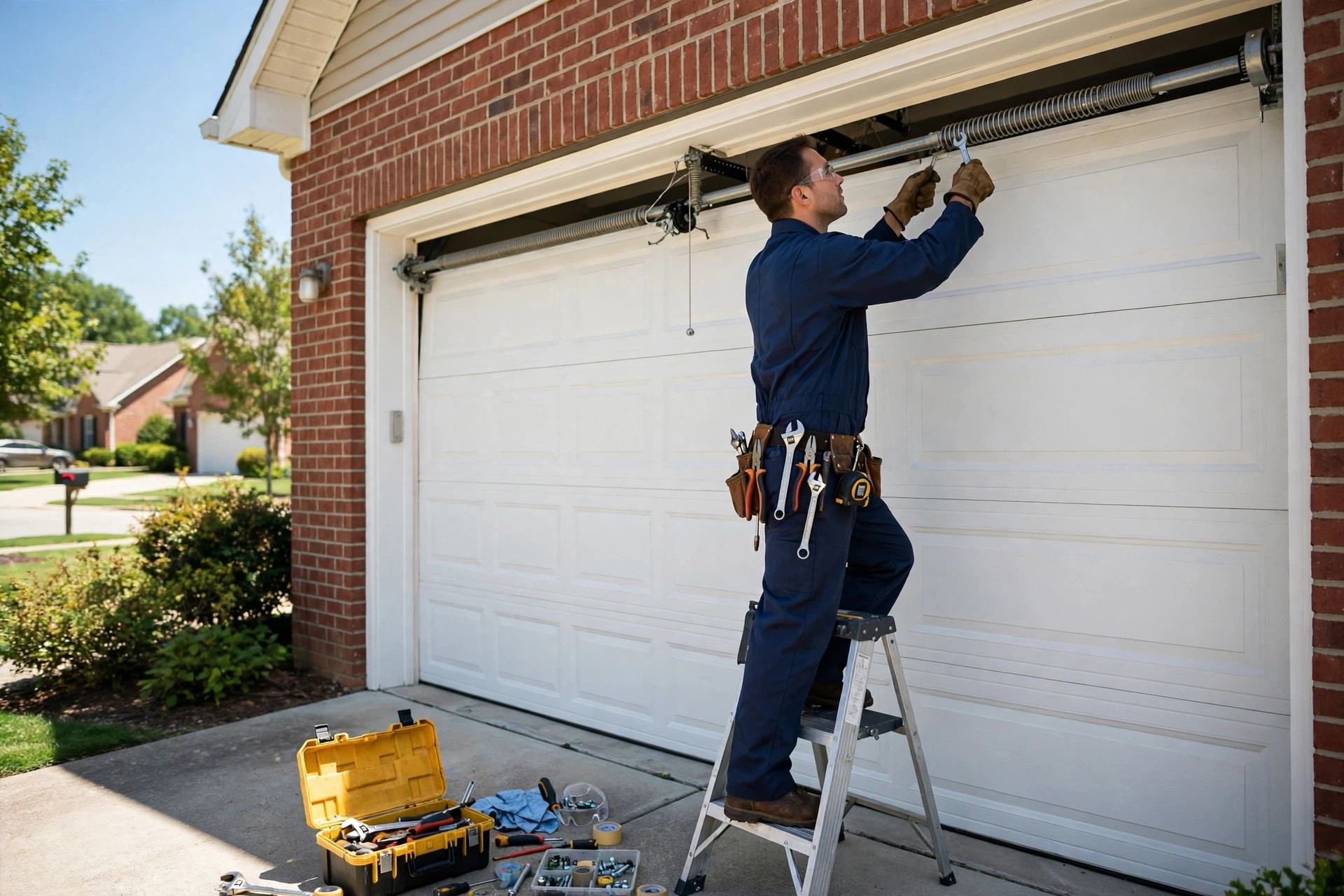
Stand inside the garage facing the closed door and look up. If you see a horizontal metal shaft running across the wall above the door, with one or two large coiled springs mounted on it, you have a torsion system. The springs sit on the shaft, flanked by cable drums at each end. This is the modern standard, fitted to the majority of doors installed in the last few decades and to nearly every heavy or wide door.
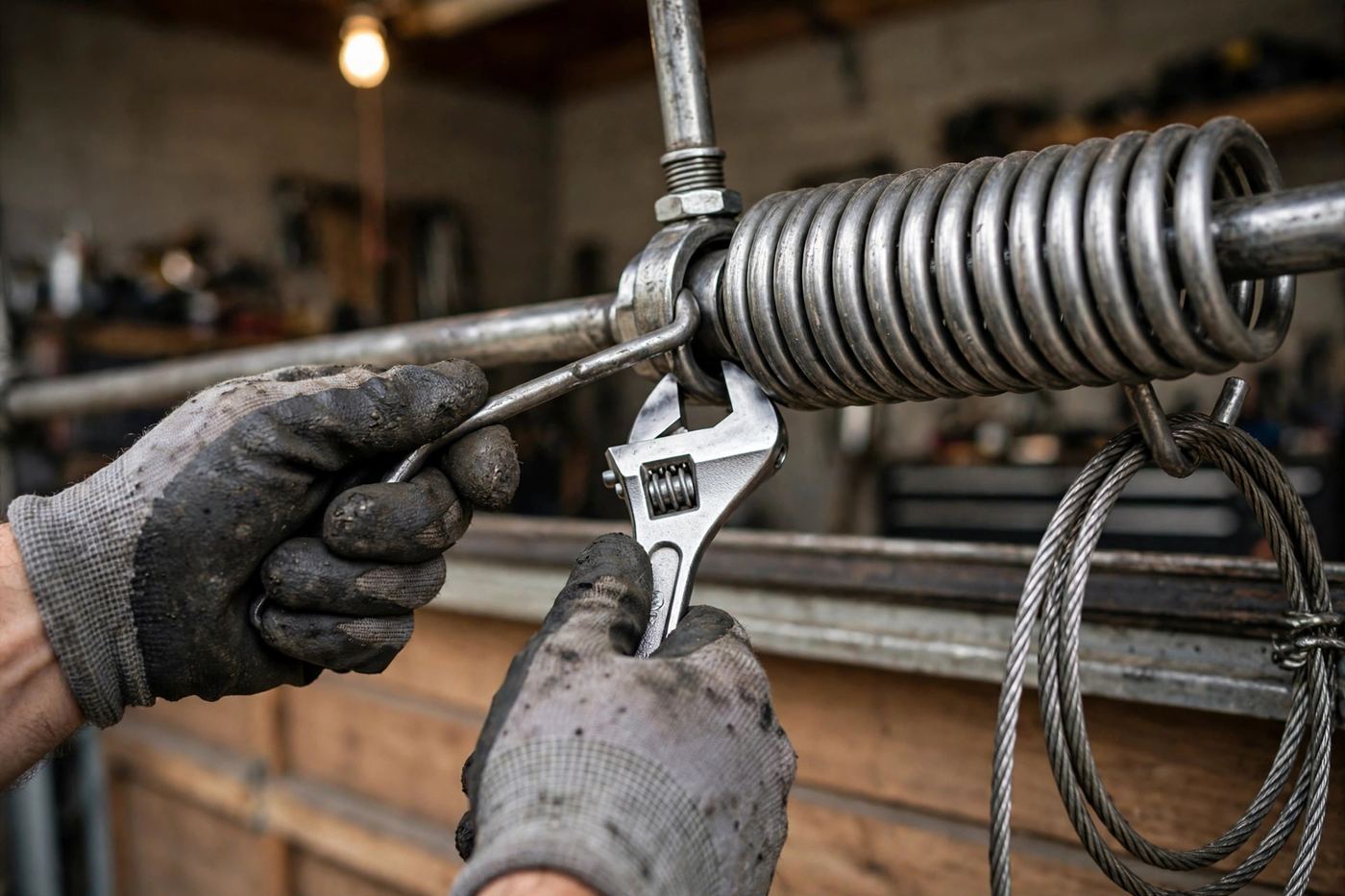
If instead you see long springs stretched along each horizontal track — running from the front of the garage toward the back, beside the tracks at roughly door height — you have extension springs. They work through pulleys and cables, extending as the door closes and contracting to help lift it as it opens. Extension systems are most common on older and lighter single doors. One identification warning: look, never touch. Both systems store serious energy, and identification requires nothing but your eyes.
How Each System Works — and How Each Fails
A torsion spring twists as the door closes, winding tighter on its shaft, and unwinds as the door opens — releasing its energy through the cables wound on the drums, lifting from the door's bottom corners. Because it lifts from a central shaft, both sides of the door receive identical force, which is why torsion doors run straight and even. When a torsion spring fails, it typically snaps into two pieces with a visible gap in the coil, and the energy releases mostly into the shaft that contains it.
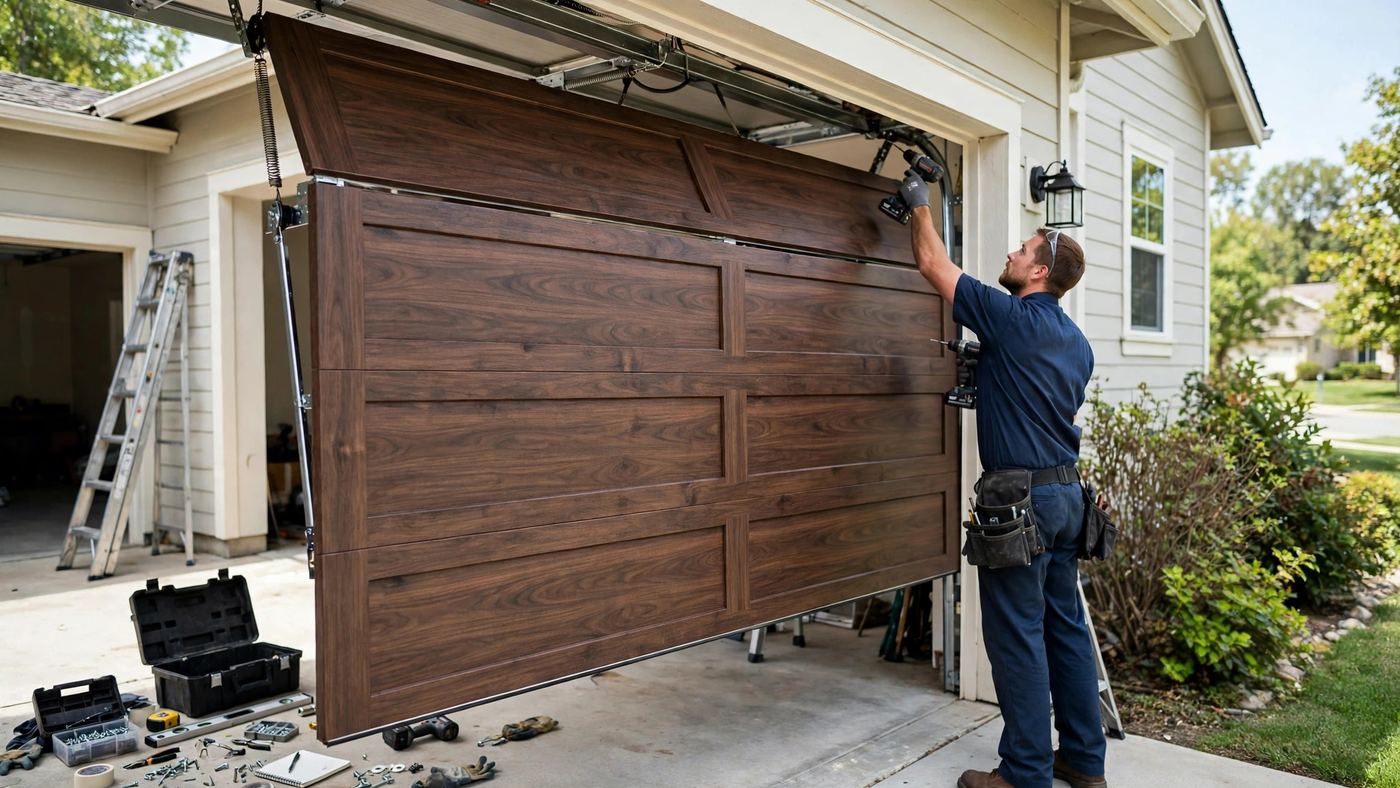
Extension springs stretch as the door closes and pull as it opens, each side working semi-independently through its own pulley and cable. The independence is the weakness: the two sides age and stretch unevenly, so an extension door in its late years often rises slightly crooked, and a spring that lets go unspools its energy along the track — which is why every extension spring must have a safety containment cable threaded through it. If you can see extension springs with no cable through the middle, that missing cable is a genuine hazard to correct at the next service visit.
The Honest Comparison: Cost, Lifespan, Smoothness, Safety
On cost, extension springs are the cheaper parts: a replacement pair runs $120-$280 including the safety cables that should always accompany them. Torsion pairs run $200-$350 installed. On lifespan, torsion wins: mounted on a shaft with controlled winding, torsion springs typically deliver their full rated cycles — about 10,000 standard, with high-cycle versions at 25,000-50,000 — while extension springs live harder lives of stretch and flex and generally land in the 5-8-year range at typical household use.
On smoothness, torsion wins as well: the central shaft applies even force, so the door travels level and quiet, and balance can be fine-tuned precisely. On safety, torsion wins most clearly — a breaking torsion spring is largely contained by its shaft, while a breaking extension spring without a containment cable can whip. The scorecard explains the market: torsion is the default on new and heavy doors, and extension persists where it was installed decades ago on light doors that ask little of it. Neither system is 'wrong' — but they are not equals, and the gap matters most at replacement time.
Converting From Extension to Torsion: When It Pays
Conversion replaces the stretch-along-the-tracks hardware with a shaft, torsion springs, drums and new cables above the door. The job typically runs $300-$500 — more than an extension pair replacement ($120-$280) — and it earns its keep under specific conditions: the door is heavy or wide (extension systems struggle to balance real weight evenly), the extension springs have failed repeatedly, the door runs crooked in a way new extension springs won't cure, or you plan to keep the home long enough to collect the longer intervals between replacements.
Conversion is not always possible or wise. The wall above the door needs room for the shaft and its bearing plates, and very low headroom can complicate it. And on a light single door with a healthy extension setup and a short ownership horizon, replacing the extension pair and moving on is the financially honest answer. The decision rule a technician will run with you: convert when the door's weight, failure history, or your time horizon makes the extension system's weaknesses a recurring bill; renew the extension system when none of those is true.
Sizing and Pairing: The Rules Both Systems Share
Whichever system you have, two rules govern replacement. First: springs are sized to the door's actual weight — expressed, for torsion springs, in wire size, inside diameter and length. A spring one size off doesn't fail dramatically; it makes the door heavy or eager, works the opener harder, and dies young. Sizing by eyeball is how doors end up with the wrong springs, and an early second failure is usually the receipt. Second: replace in matched sets. Springs installed together have lived identical lives; when one fails, its partner is in its final stretch, and a new spring paired with a tired one cannot balance the door evenly.
Ask two questions of any spring quote and you'll know whether you're dealing with a sized job or a guess: what is the new spring's cycle rating, and was the door weighed? A company that sized the spring to your door knows both numbers offhand. High-cycle upgrades — 25,000 cycles and beyond — add $50-$150 and belong in the same conversation, because the household cycle math (a busy family can spend a standard spring in under four years) is what turns a commodity repair into a once-a-decade event.
What Each System Costs Over a Decade
Run the ownership math on a typical household door at four cycles a day. Extension path: a pair at $120-$280 every 5-8 years, plus pulleys and cables aging on their own schedule — call it two replacement events a decade at the band's middle. Torsion path: a pair at $200-$350 every 7-10 years at standard rating, or a high-cycle pair that plausibly runs the whole decade untouched. The upfront gap narrows to nearly nothing over ten years, and the torsion path buys the smoother, quieter, safer system for the difference.
The numbers flip only in the short-horizon case: a light door, a healthy extension setup, and a planned move within a few years. There, the extension pair is the honest minimum and conversion money would be spent for a future owner. Technicians who ask about your time horizon before recommending are running this math; ones who don't are running a script.
Failure Stories: How Each System Announces Trouble
Torsion systems announce themselves gradually: a door that grows heavier at the manual lift test, rust blooms along the coils, a spring visibly stretched compared with its twin, and finally the bang. Extension systems announce themselves unevenly — literally: one side of the door begins rising a fraction ahead of the other as one spring stretches more than its partner, the door starts binding at one height, and the pulleys begin to squeal. A crooked rise on an extension door is the system's written warning, and it's readable months before the snap.
Both stories share the moral: the final failure is loud, but the diagnosis was available quietly for a season beforehand. The quarterly look — coils for rust and stretch, cables for fraying, rise for level — is the same five minutes regardless of your system. What differs is only where you look, which is why the first section of this guide starts with identification.
The Previous Owner's System: What to Check When You Move In
A new home inherits a spring system nobody chose for you, and the move-in inspection is worth fifteen minutes. Identify the system (shaft above the door, or springs along the tracks). If it's extension: confirm the containment cables are threaded through both springs — the single most commonly missing safety item we find — and budget their fitting if absent. Look for the age signals of either system: rust blooms, uneven rise, a door that fails the manual balance test.
Then ask the sellers' question backwards: find any paperwork — spring replacements are often invoiced and left with the opener manual, and a dated invoice tells you the system's age and rating more reliably than any guess. No paperwork plus visible age signals equals a spring system to have inspected in your first season, priced as a tune-up, rather than discovered in your first emergency.
Finally, fold the finding into your plans honestly. A healthy torsion system is a non-event for a decade. An aging extension system on a door you'll keep is a conversion conversation ($300-$500) to schedule on your terms. Either answer is fine — the only bad outcome is the surprise, and fifteen minutes at move-in is what retires it.
Torsion vs Extension at a Glance
| Item | Cost / Rating | Notes |
|---|---|---|
| Mounting | Shaft above the door | Alongside the horizontal tracks |
| Replacement pair, installed | $200-$350 | $120-$280 (incl. safety cables) |
| Typical realized life | 7-10 yrs (high-cycle: 15+) | 5-8 yrs |
| Lift evenness | Even — central shaft | Can drift crooked as springs age unevenly |
| Failure mode | Contained on the shaft | Unspools along track — needs containment cable |
| Best for | Heavy/wide doors, long horizons | Light single doors, short horizons |
Frequently Asked Questions
Which is better, torsion or extension springs?
Torsion, on most measures: longer life, smoother and more even lifting, finer balance adjustment, and a safer failure mode because the spring is contained on its shaft. Extension springs cost less to replace and are perfectly serviceable on light single doors — which is why they persist on older installations.
How do I know which type of spring I have?
Look above the door: a horizontal shaft with coiled springs mounted on it means torsion. Long springs stretched alongside the horizontal tracks mean extension. Identify by sight only — never touch either system; both store enough energy to cause serious injury.
Can I convert my extension springs to torsion?
Usually, yes — if there's room above the door for the shaft hardware. Conversion runs $300-$500 and pays off on heavy or wide doors, on repeatedly failing extension systems, and when you plan to stay in the home. On a light door with a short horizon, renewing the extension pair is the smarter spend.
Do extension springs need safety cables?
Absolutely. A containment cable threaded through each extension spring is what keeps a breaking spring from whipping across the garage. If your extension springs have no cable through them, treat that as a defect to fix at the next service visit — it's inexpensive and it's the difference between a failure and an injury.
How long do torsion and extension springs last?
Both are rated in cycles (one open plus one close). Standard springs of either type are rated around 10,000 cycles, but extension springs typically realize 5-8 years at household use while torsion systems more reliably reach their rating — and torsion is available in high-cycle versions (25,000-50,000 cycles) that can triple the interval.
Are extension springs dangerous?
They carry the same fundamental rule as all spring work — professional-only — plus one specific requirement: a safety containment cable threaded through each spring, so a breaking spring can't whip across the garage. With containment cables fitted and inspections kept, an extension system is a legitimate, serviceable design; without them, it's an unfinished one.
Related Services
Broken Spring Replacement
Snapped torsion or extension spring? We replace springs in matched pairs, sized exactly to your door's weight — same-day.
Learn more about broken spring replacement →Garage Door Cable Repair
Snapped or frayed lift cables leave doors crooked and dangerous. We replace cables in pairs with drums inspected and reset.
Learn more about garage door cable repair →Garage Door Maintenance & Tune-Up
A full tune-up: balance test, lubrication, hardware tightening, sensor and safety checks — the cheapest way to avoid a breakdown.
Learn more about garage door maintenance & tune-up →← All garage door guides · Costs & pricing hub
Garage Door Stuck? We Can Fix It Today.
Same-day appointments and 24/7 emergency service across all 50 of our service cities. Upfront price before work starts — no surprises on the invoice.
(210) 964-8892 ☎ Call Now — Open 24/7