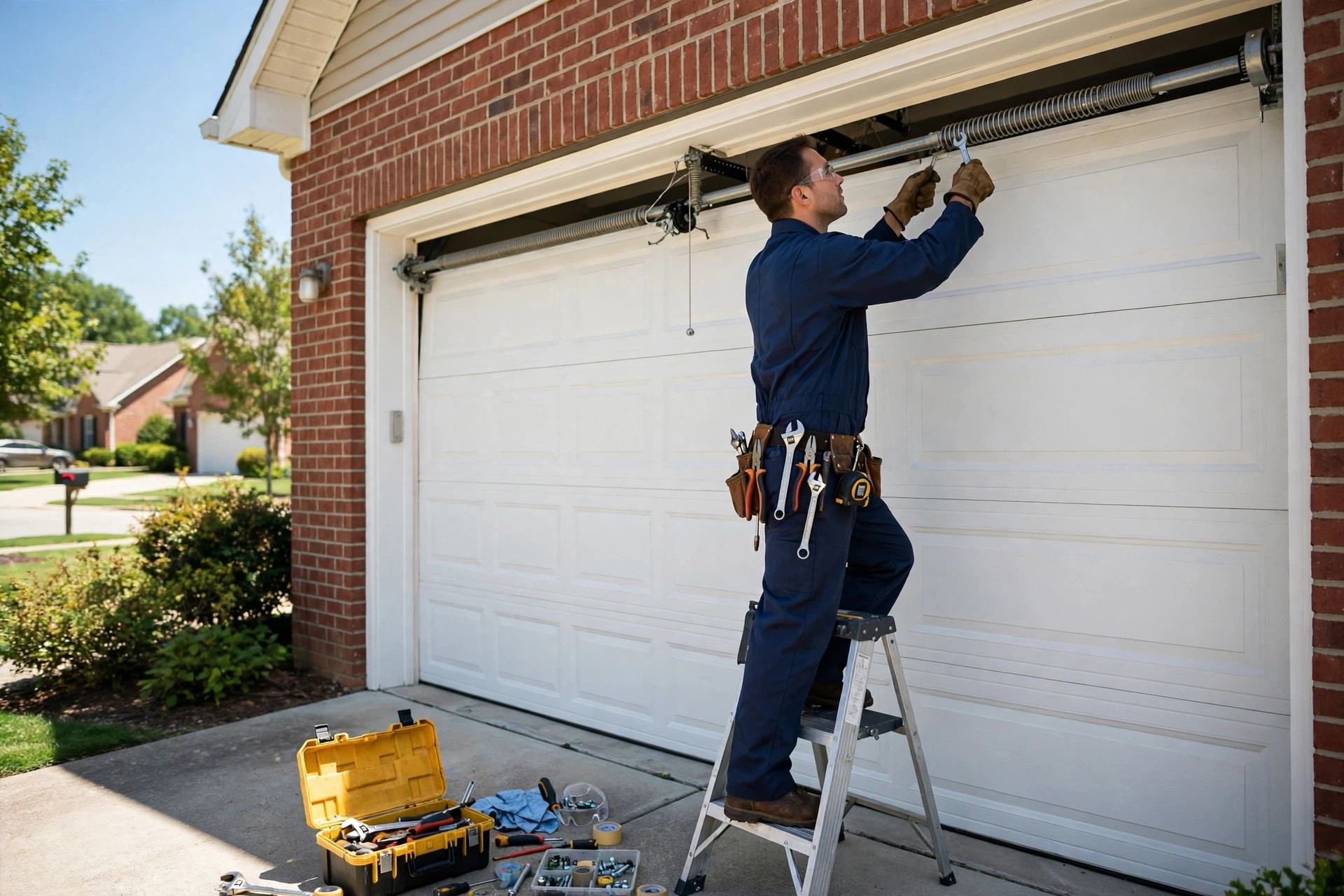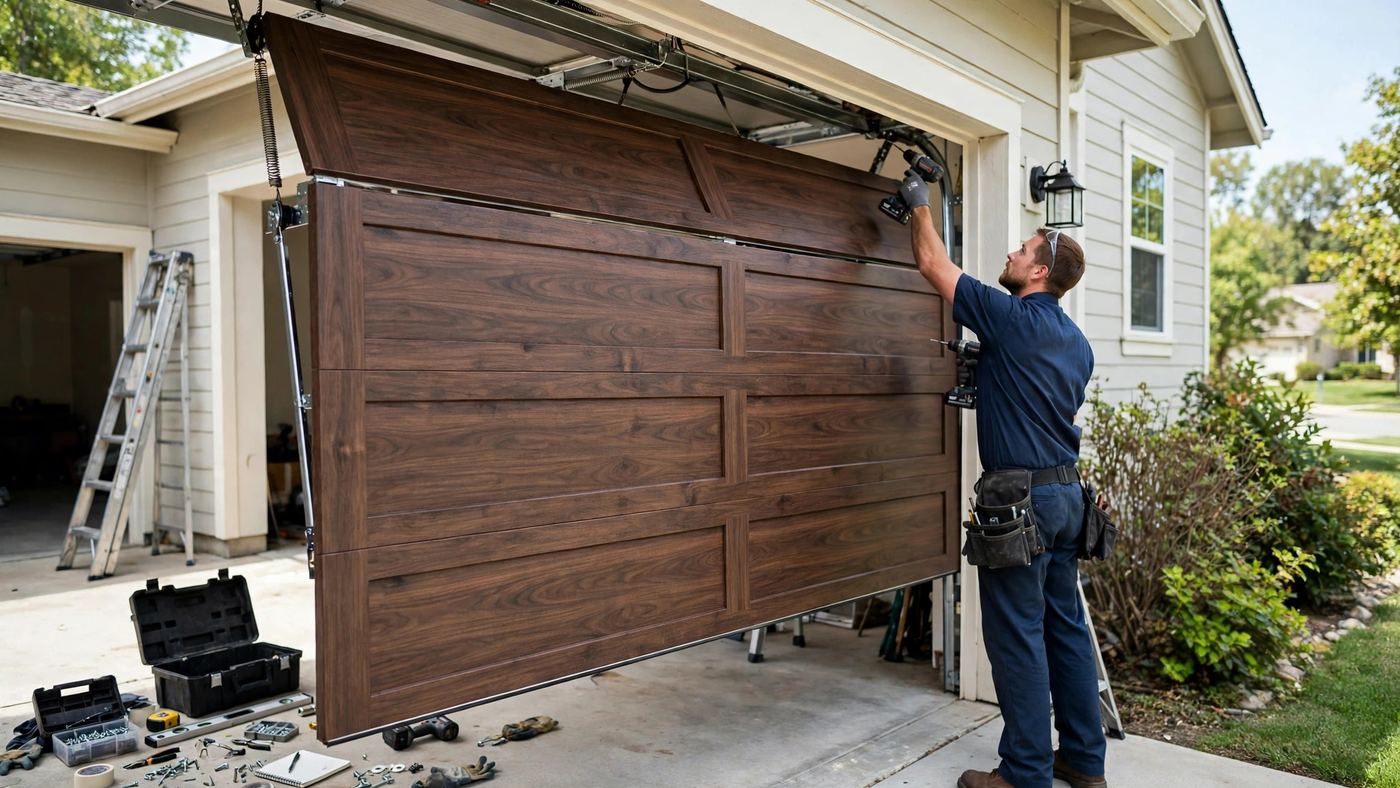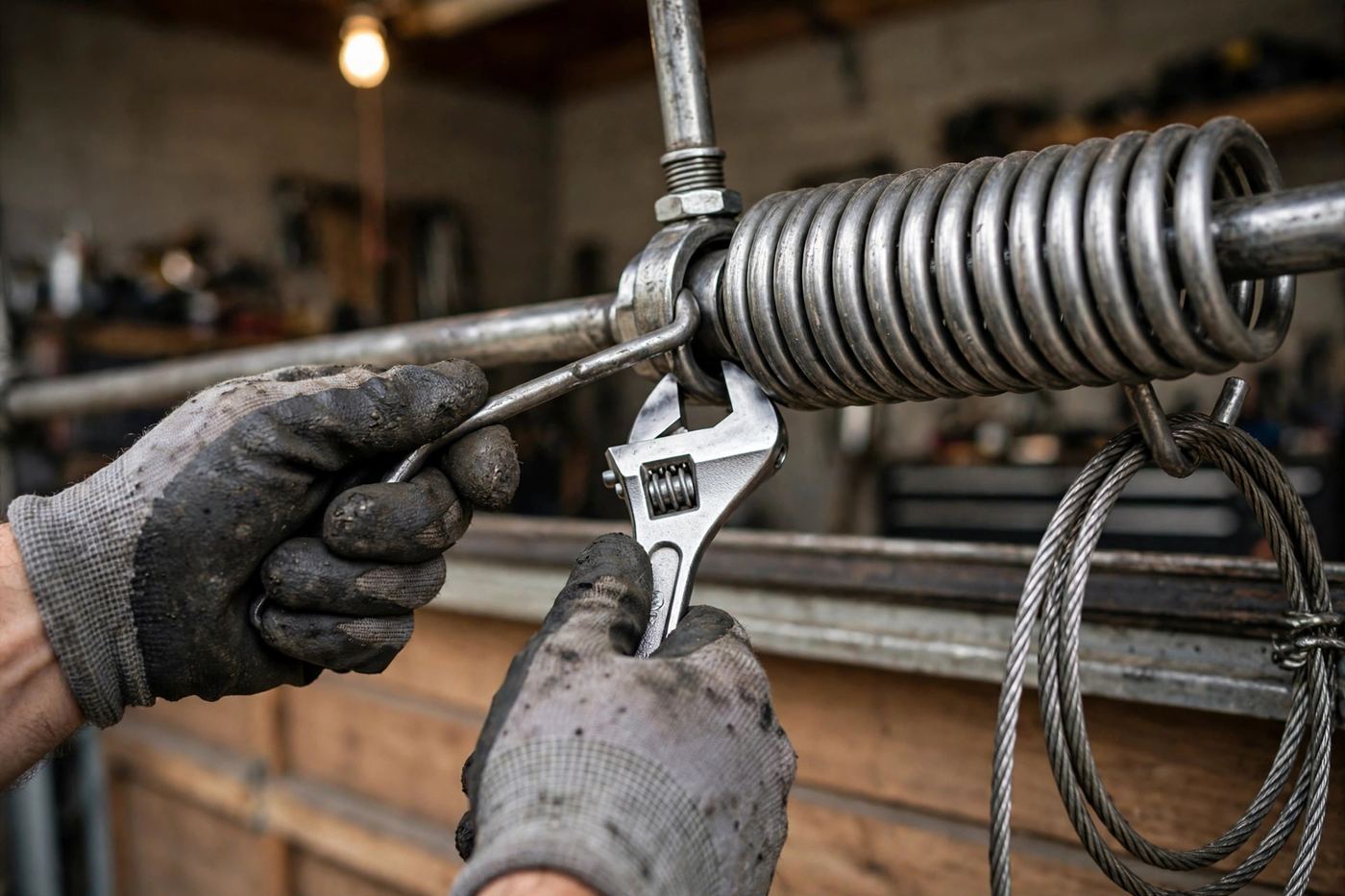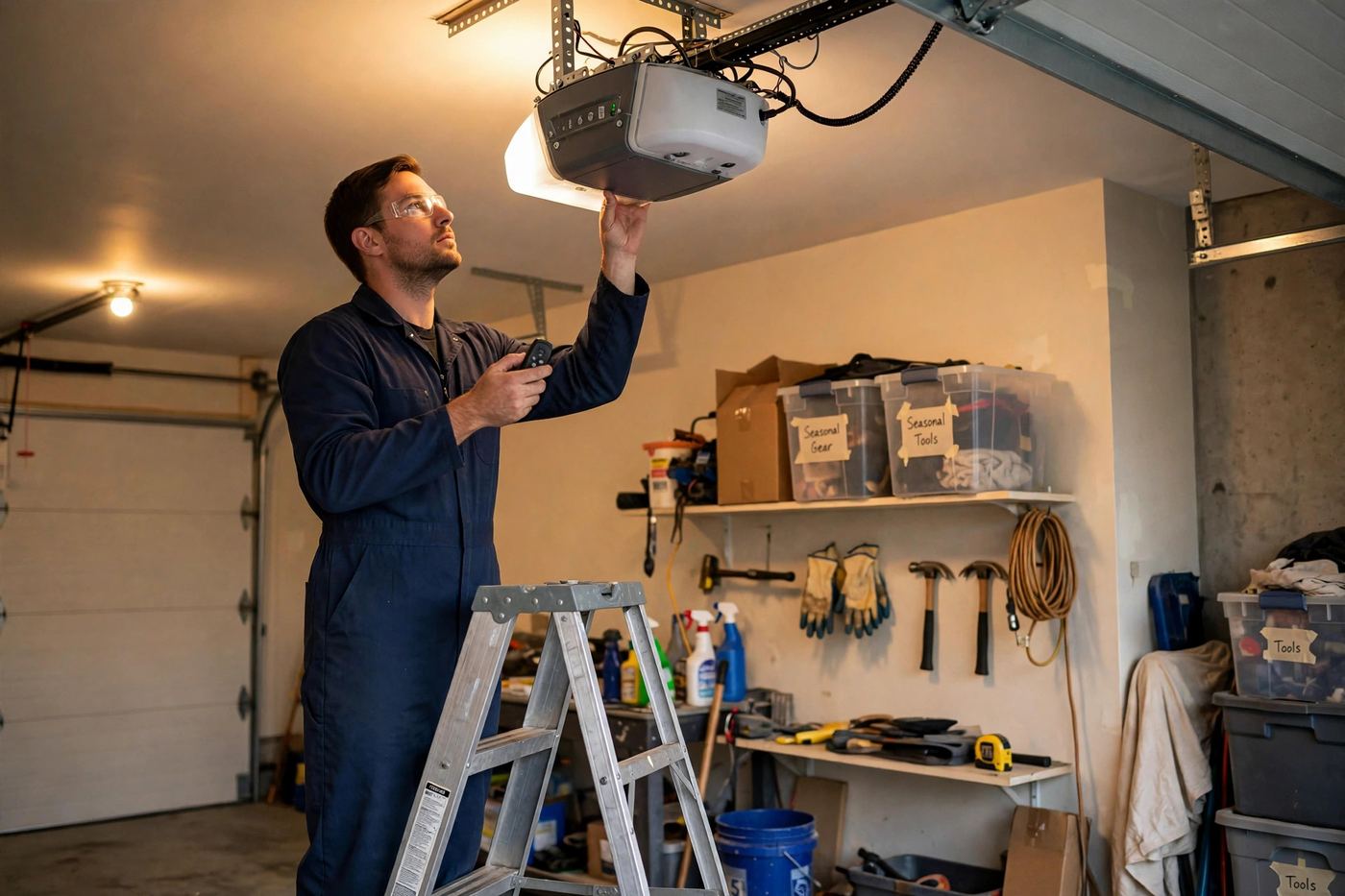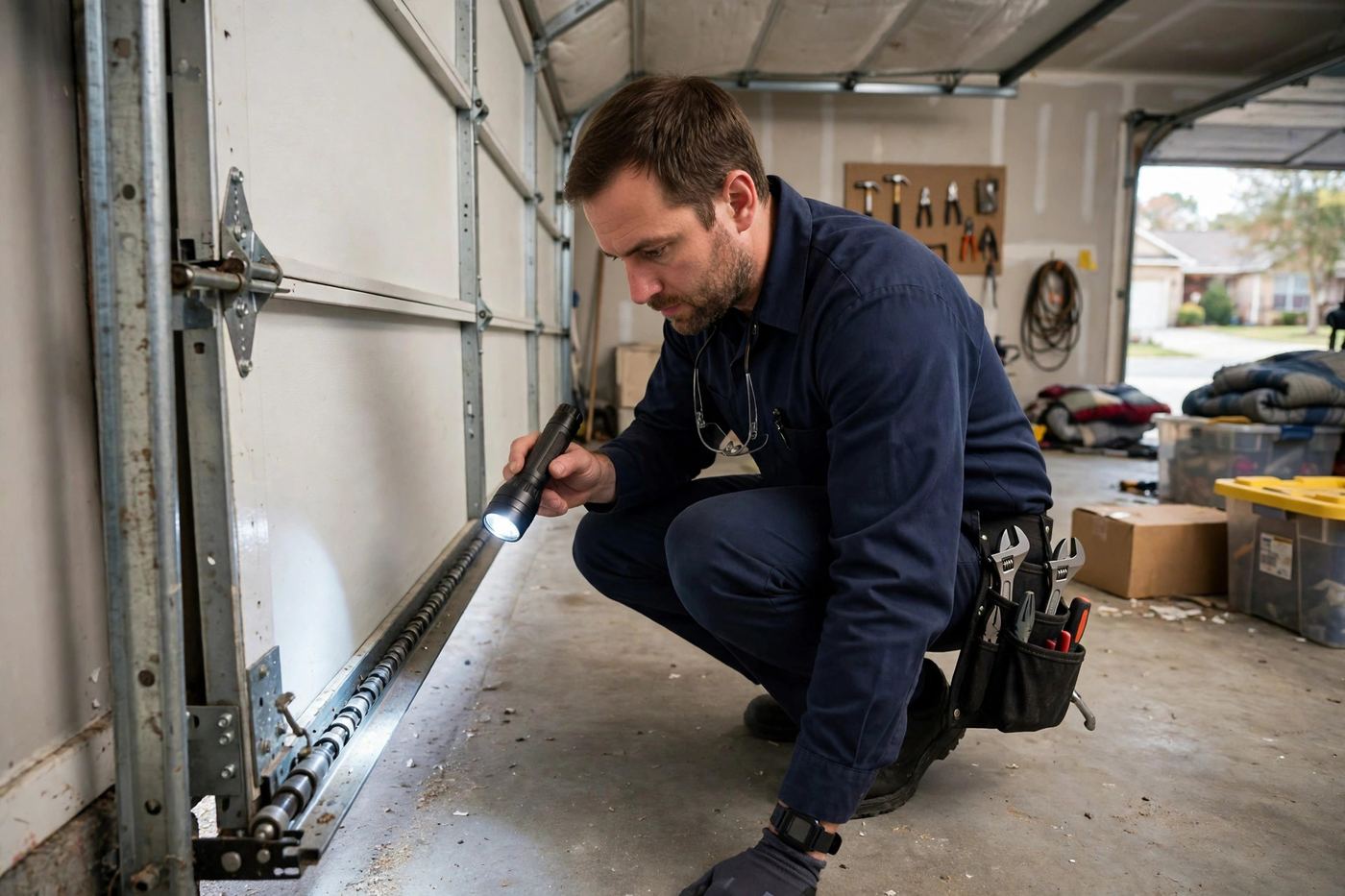
The essential safety note first: if the door is very heavy to lift manually or you can see a gap in the coil spring above the door, stop. You're looking at a counterbalance failure, and forcing the door risks damage and injury. That's a same-day professional fix, not a wrestling match.
In This Guide
- Total Silence: Power, Lockout and Remote Problems
- The Opener Hums but Nothing Moves
- Lifts a Few Inches, Then Quits: The Broken Spring Signature
- Opens Partway and Stops Mid-Travel
- The Manual Lift Test: Your Best Diagnostic
- The Trapped Car Playbook
- After the Fix: Preventing the Sequel
- After the Outage: Resetting the Opener Correctly
Key Takeaways
- Start stupid-simple, because a third of 'dead door' calls live here: is the opener plugged in and the outlet live (garages often share a GFCI that trips silently)? Is the wall switch's vacation/lock mode engaged — many wall panels have a lock button that disables remotes entirely, and it gets pressed by accident more than you'd think.
- A humming motor with no travel usually means one of three things: the drive gear is stripped (common on older chain-drive units — the motor spins, the stripped nylon gear doesn't engage), the start capacitor has failed (the motor can't get its initial torque), or the door is locked/bound and the opener is straining against it.
- This is the textbook presentation of a broken spring.
- A door that stops at a consistent height usually meets resistance at that point: a roller that seizes at the track curve, a hinge that binds, a dent making sections pinch, or — in cold climates — ice bonding the bottom seal to the floor or frozen track joints.
- With the door closed, pull the release and lift.
- If the car is inside and the door won't open: first, diagnose from this guide — if it's a remote, lock-mode or power issue, you may be driving in ten minutes.
- Every won't-open cause has a preventive twin.
- Power outages strand more doors through confusion than through damage.
How to use this guide: work the checks in the order given — they're sequenced from the most common and cheapest causes to the rarest and most involved, which is exactly how a technician's diagnosis proceeds. Stop at the step that solves it, and stop entirely at anything involving springs, cables or a door that's crooked or off its tracks: those are professional jobs, and this guide will tell you plainly when you've reached one. If you reach the end without a fix, call (210) 964-8892 and tell the dispatcher which steps you completed — you'll skip half the diagnosis and get the right parts on the first truck.
Total Silence: Power, Lockout and Remote Problems
Start stupid-simple, because a third of 'dead door' calls live here: is the opener plugged in and the outlet live (garages often share a GFCI that trips silently)? Is the wall switch's vacation/lock mode engaged — many wall panels have a lock button that disables remotes entirely, and it gets pressed by accident more than you'd think. Try the wall switch: if it works and remotes don't, you've narrowed it to batteries, programming, or interference.
Remote batteries are a yearly item most people never change. After any power outage, some openers need remotes re-paired. And the modern gremlin: cheap LED bulbs screwed into the opener can flood its radio receiver with interference — if remote range died when you changed a bulb, swap back to an incandescent or opener-rated LED and test.
The Opener Hums but Nothing Moves
A humming motor with no travel usually means one of three things: the drive gear is stripped (common on older chain-drive units — the motor spins, the stripped nylon gear doesn't engage), the start capacitor has failed (the motor can't get its initial torque), or the door is locked/bound and the opener is straining against it. Disconnect the opener with the release cord and check the door manually before running the opener again — repeated attempts against a bound door turn a small fault into a burned motor.
Gear kits run $120-$250 installed and capacitors $90-$180; both are classic worth-fixing repairs on an otherwise healthy opener. If the hum comes with a burning smell, unplug the unit and call — electrical faults don't improve with retries.
Lifts a Few Inches, Then Quits: The Broken Spring Signature
This is the textbook presentation of a broken spring. The opener starts the lift with the door's dead weight, its force sensor trips within inches, and it stops to protect itself. Look up at the spring shaft: a torsion spring with a visible gap of a few inches in the coil has snapped (it may also have made a loud bang when it let go — many people report hearing what sounded like a gunshot or a falling bookshelf).
Do not keep trying, and do not attempt a manual lift: without counterbalance the door weighs 150-400 pounds and can drop. Spring replacement is $120-$350, is standard same-day work, and includes rebalancing and opener recalibration. Your car may be trapped meanwhile — tell the dispatcher; trapped-car calls get prioritized.
Opens Partway and Stops Mid-Travel
A door that stops at a consistent height usually meets resistance at that point: a roller that seizes at the track curve, a hinge that binds, a dent making sections pinch, or — in cold climates — ice bonding the bottom seal to the floor or frozen track joints. Walk the door up manually (opener disconnected) and feel for the sticky point; the location of the bind is diagnostic gold for the technician.
Inconsistent stopping points suggest opener-side issues: force settings drifting, a failing capacitor that can't sustain torque, or overheating (thermal cutout after several runs in a row — if it works again after 20 minutes of rest, heat is your suspect and the opener is telling you it's tired or the door is too heavy).
The Manual Lift Test: Your Best Diagnostic
With the door closed, pull the release and lift. Balanced and healthy: the door rises with modest effort and stays at halfway when released. Too heavy or slamming down: spring problem. Rises eagerly and wants to fly up: spring over-tensioned (rarer, also a pro adjustment). Binds or jerks at a point: track, roller or hinge problem at that height. Crooked rise: cable or drum problem.
That two-minute test splits the entire fault tree — door vs. opener, counterbalance vs. travel — and it's exactly what a technician does first. Give the dispatcher your result when you call (210) 964-8892 and the truck arrives stocked for your actual problem.
The Trapped Car Playbook
If the car is inside and the door won't open: first, diagnose from this guide — if it's a remote, lock-mode or power issue, you may be driving in ten minutes. If it's a broken spring, do not attempt the heroic two-person lift you found in a forum: a 16-foot insulated door without counterbalance can weigh 300 pounds and drops faster than people move. Call us, say the words 'car trapped,' and the call jumps the queue — dispatchers are trained for exactly this.
While waiting, gather the door's details: single or double, opener brand, what you heard (the bang is diagnostic). If the garage has a side door or the house connects, you're comfortable; if the garage is your only entrance issue — say, a detached garage with the car inside — tell dispatch that too. Information is what turns an emergency slot into a rescue.
After the Fix: Preventing the Sequel
Every won't-open cause has a preventive twin. Springs: replace tired ones in the fall, before the cold-snap failure season, and buy cycle rating matched to your use. Openers: a surge protector ($25) against the board failure that follows storms, and a battery-backup unit so outages stop being door events. Remotes: fresh batteries yearly — put it on the smoke-detector schedule — and erase-and-reprogram when you move in or a remote goes missing.
And the habit that catches everything else: the two-minute manual lift test, twice a year. A door drifting out of balance announces next season's breakdown while it's still a $150 adjustment. No other two minutes in home maintenance buys as much warning.
After the Outage: Resetting the Opener Correctly
Power outages strand more doors through confusion than through damage. When power returns, work this sequence before concluding anything is broken: confirm the outlet is live (test with a lamp — garage outlets often hang on a tripped GFCI in a bathroom or exterior box, a genuinely common gotcha). Check the wall panel for lock mode. Then test the wall switch before the remotes, because remotes are the first thing outages scramble.
If remotes forgot their programming, re-pair them at the Learn button per your manual. If the door travels but stops short or reverses oddly after an outage, the travel limits may need re-teaching — most modern openers have a documented reset procedure; follow it exactly rather than improvising with the adjustment dials.
And if the opener is simply dead after a storm despite a live outlet, you're likely looking at the board — the surge casualty. That's the moment the surge protector conversation stops being theoretical: fit one with the repair, or the next storm gets a vote on your new board too.
Won't-Open Causes by Symptom
| Item | Cost / Rating | Notes |
|---|---|---|
| Total silence, nothing responds | Power, GFCI, lock mode | Check outlet, wall panel lock |
| Motor hums, no movement | Stripped gear or capacitor | Pro repair $90-$250 |
| Lifts inches, then stops | Broken spring (classic) | Pro repair $120-$350 — do not force |
| Stops at same height | Bind: roller, hinge, track | Locate the sticky point |
| Works after resting 20 min | Opener overheating | Door too heavy or motor failing |
Frequently Asked Questions
My car is trapped in the garage. What do I do?
Call (210) 964-8892 and say so — trapped-car calls are prioritized. If the door is balanced and undamaged, a dispatcher may walk you through a safe manual release. If a spring is broken, wait for the technician; the door is far heavier than it looks.
How much does it cost to fix a door that won't open?
It depends entirely on the cause: batteries and settings are nearly free; springs run $120-$350; opener gears $120-$250; capacitors $90-$180. Diagnosis identifies which in minutes.
The opener light blinks when I try to open. What does that mean?
Blinking patterns are error codes — commonly a lock-mode engagement or a sensor fault. Count the blinks and check your manual, or tell the dispatcher the pattern; it's genuinely useful information.
Can a power outage break my opener?
Outages themselves rarely do, but the surge when power returns can damage the logic board. If the opener died right after a storm or outage and remotes stopped working with it, the board ($150-$300) is the likely suspect — and a surge protector prevents the sequel.
Is it safe to force the door open with a broken spring?
No. The door's full weight — often 200+ pounds — is unsupported, and it can drop without warning once moved. This is the single most common garage-door injury scenario. Leave it and call.
The power is out. How do I open the door manually?
If the door is balanced and undamaged: pull the red release cord to disconnect the opener, then lift slowly with both hands — it should feel light. Lift only to the height you need, and never stand under a door you're unsure of. If it's heavy, crooked, or a spring is broken, skip the manual lift entirely and wait for the technician.
Related Services
Garage Door Repair
Complete diagnosis and repair for doors that won't open, close, balance or seal — most repairs finished in a single visit.
Learn more about garage door repair →Broken Spring Replacement
Snapped torsion or extension spring? We replace springs in matched pairs, sized exactly to your door's weight — same-day.
Learn more about broken spring replacement →Garage Door Opener Repair
Opener hums, clicks or runs but the door won't move? We repair motors, gears, belts, boards and sensors for all major brands.
Learn more about garage door opener repair →← All garage door guides · Costs & pricing hub
Garage Door Stuck? We Can Fix It Today.
Same-day appointments and 24/7 emergency service across all 50 of our service cities. Upfront price before work starts — no surprises on the invoice.
(210) 964-8892 ☎ Call Now — Open 24/7