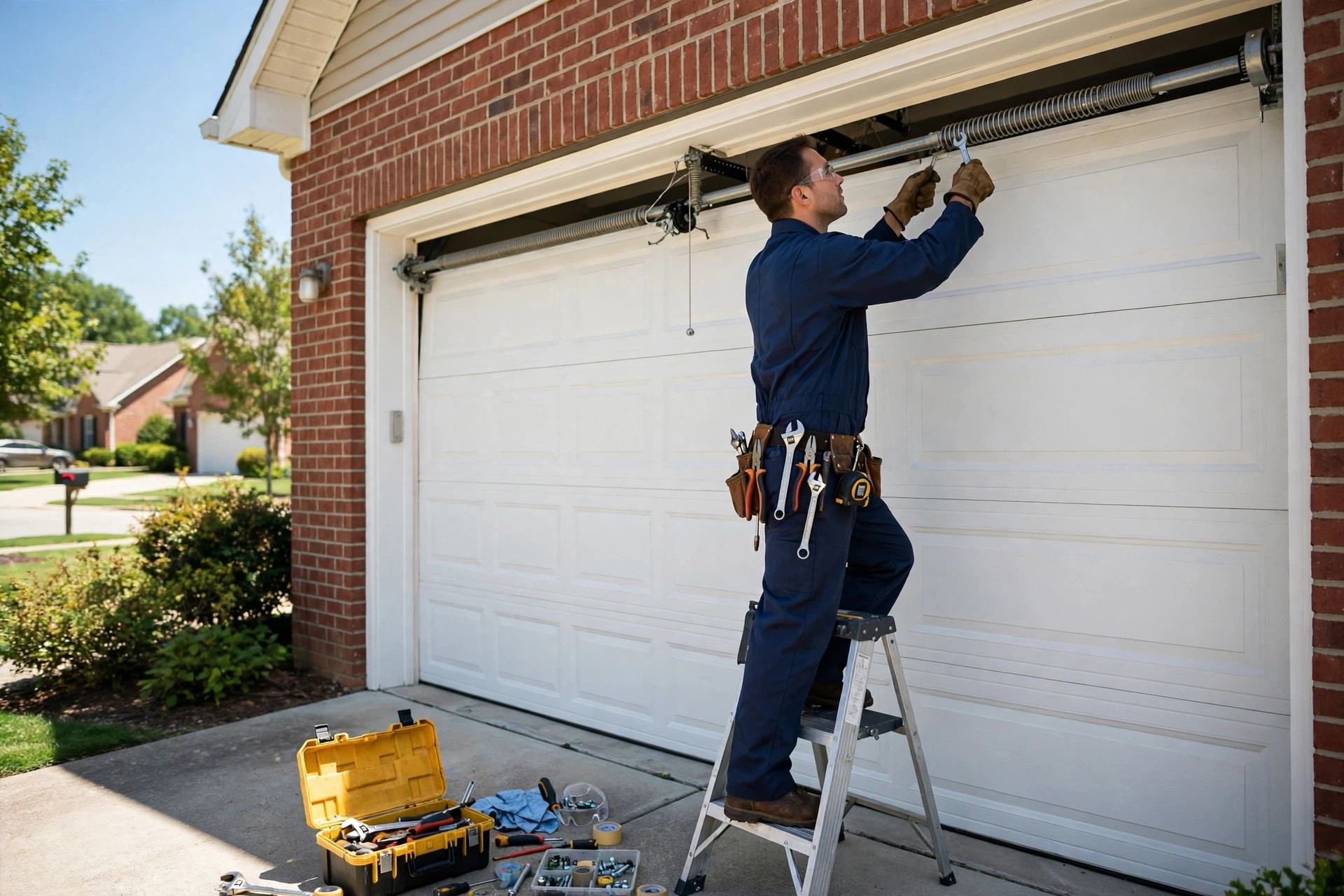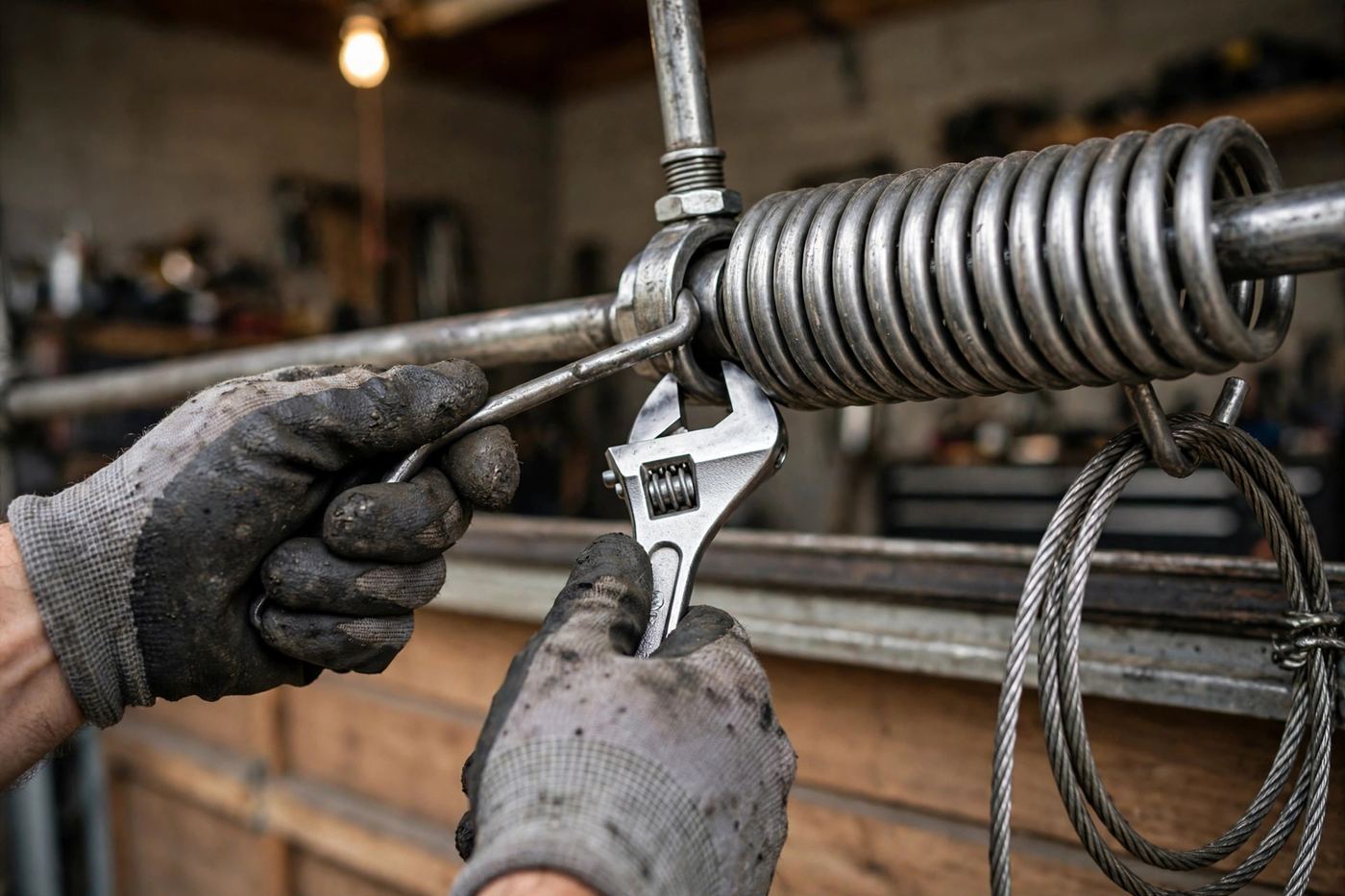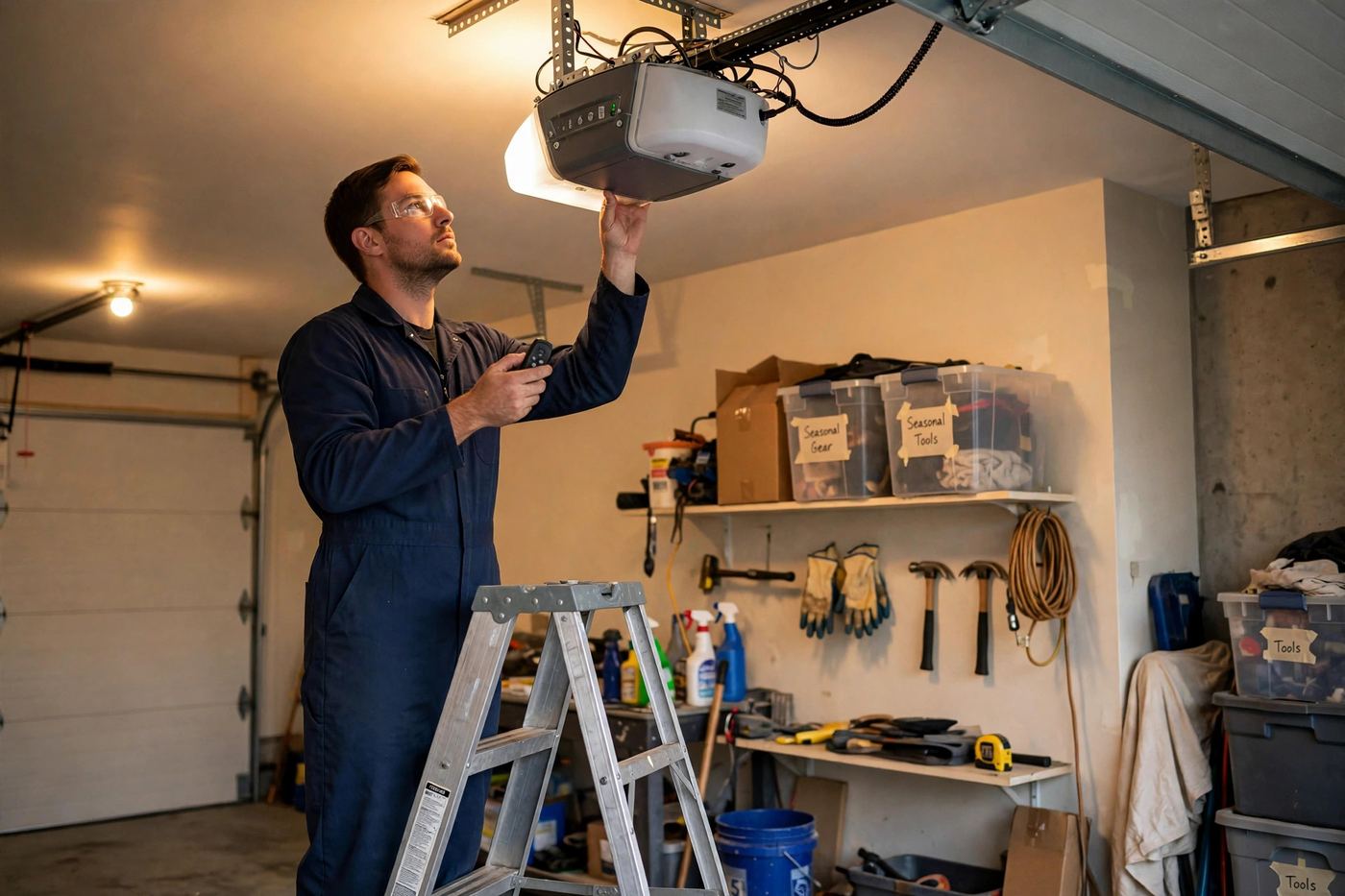
Start tonight with security, not diagnosis: if the door is opening on its own, lock it down — engage the manual slide lock if your door has one, and unplug the opener so nothing can command it until morning. Only pull the emergency release cord if the door is closed, balanced and undamaged; a door with a broken spring or a crooked hang must stay exactly as it is. Then work the causes below in daylight. Most phantom openings end at a stuck remote button or a dying wall control — a $0-$150 fix — and the expensive answer, a logic board, is the one you should only reach after the cheap ones are ruled out.
In This Guide
- First, Rule Out the Obvious: Remotes, Keypads and the Car
- The Wall Control: The Short That Opens Doors
- Radio Interference and the Neighbor's Opener
- Wiring, Logic Boards and the Ghost in the Opener
- Security First: What to Do Tonight
- The Rolling-Code Era: Why Old Fixed-Code Openers Are the Usual Suspects
- When Phantom Opening Means Replace, Not Repair
- The Overnight Test: Proving the Fix Before You Trust It
Key Takeaways
- Most phantom openings are a button being pressed by something that is not a person.
- The wall button is the most overlooked suspect because it never moves.
- Openers listen on a radio frequency, and the air around your garage is busier than it looks.
- When every control is disconnected and the door still opens, the ghost lives inside the opener.
- Until the cause is found, treat the door as unsecured and act accordingly.
- Garage door remotes learned to keep secrets in the late 1990s, and openers made before that change are the usual suspects in every phantom-opening story.
- Three findings point at replacement rather than another repair.
- A phantom-opening fix is not proven by the afternoon it was applied; it is proven by the morning after.
How to use this guide: work the checks in the order given — they're sequenced from the most common and cheapest causes to the rarest and most involved, which is exactly how a technician's diagnosis proceeds. Stop at the step that solves it, and stop entirely at anything involving springs, cables or a door that's crooked or off its tracks: those are professional jobs, and this guide will tell you plainly when you've reached one. If you reach the end without a fix, call (210) 964-8892 and tell the dispatcher which steps you completed — you'll skip half the diagnosis and get the right parts on the first truck.
First, Rule Out the Obvious: Remotes, Keypads and the Car
Most phantom openings are a button being pressed by something that is not a person. A remote wedged between car seats, a remote at the bottom of a bag under a heavy object, a key fob clipped to a key ring that presses against the visor clip — all of them can hold a button down long enough to send the open command, and the door obeys without asking who pressed it. Children discovering the remote are a classic; so is the car's built-in HomeLink button being leaned on by a sun visor or a phone mount. The test costs nothing: take every remote out of the cars and the house, remove their batteries, and see whether the door still opens on its own.
The keypad deserves the same suspicion. A keypad button stuck down by cold, moisture or a swollen membrane can send its code repeatedly, and a keypad whose cover has cracked lets rain do the pressing. If the door stops opening by itself once the remotes are out of range and the keypad battery is pulled, you have found the family — replace the offending control ($25-$75 for a remote or keypad, part only) and re-teach the household set. If it still opens with every control removed, the cause is inside the opener or its wiring, and the next sections apply.
The Wall Control: The Short That Opens Doors
The wall button is the most overlooked suspect because it never moves. Inside it, two contacts close when you press — and when the button wears, moisture gets in, or a staple or nail nicks the low-voltage wire running from the opener to the wall, those contacts can close on their own. The signature is a door that opens at odd hours with no remote anywhere near it, often after rain or in humid weather. The test is decisive: disconnect the wall control wires at the opener's terminals and leave the door powered overnight. If the phantom openings stop, the wall control or its wire is the fault.
Replacement is a $75-$150 visit — a new wall control, a check of the wire run for staples and moisture, and a re-test. What the test also rules out matters: if the door still opens with the wall control disconnected and every remote removed, the problem is not a control at all, and you have just saved yourself from replacing parts that were never guilty. Tell the dispatcher the result of this test when you call; it is the single most useful sentence in the whole diagnosis.
Radio Interference and the Neighbor's Opener
Openers listen on a radio frequency, and the air around your garage is busier than it looks. A neighbor's remote on an older fixed-code opener can share your code — the classic case is two houses built the same year with openers set to the same dip-switch combination, where one family's remote has opened the other's door for a decade unnoticed. New electronics in the house can do it too: the cheap unshielded LED bulb screwed into the opener is the famous one, flooding the receiver's frequency so the opener misreads noise as a command, and the fix is a $0-$25 bulb swap to an incandescent or opener-rated LED.
The pattern to watch is timing. Openings that cluster around a neighbor's comings and goings, or that started the week a new bulb went in, or that began when the house across the street got a new opener, all point at the radio environment rather than the hardware. The durable fix is the erase-and-reteach: hold the Learn button for about six seconds to wipe every device the opener knows, then teach back only your own remotes, keypad and cars on fresh codes. On a modern rolling-code opener that reset closes the neighbor chapter permanently; on a pre-1997 fixed-code opener it only reshuffles it, which is why the next section's age question matters.
Wiring, Logic Boards and the Ghost in the Opener
When every control is disconnected and the door still opens, the ghost lives inside the opener. The usual resident is the logic board: a relay on the board sticks closed, or a surge — the one that arrives when power returns after an outage — damages the board's receiver so it fires on noise. The signature is openings with no pattern at all, sometimes several in an hour, sometimes silent for days, and often beginning right after a storm or a power cut. Heat is the other accomplice: a board that has cooked in a hot garage for fifteen summers fails exactly this way, intermittently, before it fails completely.
This is the diagnosis that costs $150-$300 for the board, and it is also the diagnosis that should make you ask the age question. On an opener past 12-15 years, a new board buys you a repaired old opener with old gears, an old motor and no battery backup — against a new opener at $350-$850 with every control in the box and a fresh warranty. The repair-or-replace math is the same test our opener guide applies, and phantom opening caused by a dying board is one of the cleaner cases for replacement: the symptom is a security failure, and a security failure is not the place to economize.
Security First: What to Do Tonight
Until the cause is found, treat the door as unsecured and act accordingly. Unplug the opener — a door that cannot be commanded cannot open by itself, and unplugging is the one fix that works on every cause on this page. If your door has a manual slide lock, engage it; if it does not, and the door is closed, balanced and undamaged, you may pull the release cord and lock the door from the inside, but only after the balance check — a heavy or crooked door stays exactly as it is. Move anything irreplaceable out of the garage for the night, and lock the interior door to the house.
In the morning, run the tests in this guide's order and note what you find: which controls were removed, whether the openings stopped, and the times they happened. Then erase all codes and re-teach only your own devices, change the keypad PIN, and — if the opener predates rolling codes — ask about replacement rather than another round of reprogramming. A door that opens by itself is not a quirk to live with; it is a lock that sometimes unlocks itself, and locks that do that get fixed or replaced.
The Rolling-Code Era: Why Old Fixed-Code Openers Are the Usual Suspects
Garage door remotes learned to keep secrets in the late 1990s, and openers made before that change are the usual suspects in every phantom-opening story. A fixed-code opener — the kind set with little dip switches inside the remote — broadcasts the same code every time it is pressed, from a set small enough that a neighbor's remote, a lost remote, or a code grabbed from the air can match it. Two houses built the same year with openers set to the same combination have opened each other's doors for decades, usually unnoticed until someone's schedule changes and the pattern becomes visible.
Modern rolling-code openers (Security+ and its peers) change the code with every press, so a captured code is useless a second later and a neighbor's remote cannot stumble onto yours. If your opener still uses dip switches, no amount of reprogramming will make it secure — the erase-and-reteach only reshuffles a small deck. The honest fix is a new opener at $350-$850, which also buys battery backup, app control and safety sensors a pre-1993 unit may lack entirely. A phantom-opening door on a fixed-code opener is not a fault to chase; it is an upgrade waiting for its reason.
When Phantom Opening Means Replace, Not Repair
Three findings point at replacement rather than another repair. The first is age with a board fault: an opener past 12-15 years whose logic board is firing on its own is an old machine with old gears, an old motor and a board that will be followed by the next-oldest part. The second is a fixed-code opener, above — the security model itself is the fault. The third is a door whose phantom openings survived every test on this page: every control removed, wall control disconnected, codes erased, bulb swapped, and it still opens. That opener has told you everything it can, and the next dollar spent on it is a dollar spent twice.
The replacement conversation is also the moment to fix the things the old opener never had: battery backup so the door works in an outage, a belt drive if the garage is attached and the chain wakes the house, and app control with open/close alerts so a door that ever opens unexpectedly tells your phone about it. The installed total for a modern belt-drive unit with backup is typically $450-$750, and the alerts alone retire the anxiety that a phantom-opening door creates — because the question stops being whether the door opened, and becomes knowing the moment it does.
The Overnight Test: Proving the Fix Before You Trust It
A phantom-opening fix is not proven by the afternoon it was applied; it is proven by the morning after. The test is simple and it costs nothing: after the repair — the new wall control, the erased and re-taught codes, the bulb swap, the new board — leave the door closed with the opener plugged in overnight, and check it first thing in the morning. A door that stayed shut through the coldest, quietest hours has passed the test that matters, because the night is when marginal shorts close and interference does its work.
If it opens again, the overnight test has still done its job: note the time, and note what changed. An opening at 2 a.m. after a dry day points at temperature and wiring; an opening at the hour the neighbor leaves for work points at radio; an opening with no pattern at all, after every control was removed, points at the board and the replacement conversation. Bring that log to the next visit — a technician who knows the time and the conditions does not have to guess, and the second visit is usually the last one. Trust, on a door that once opened by itself, is earned one quiet night at a time.
Phantom Opening Causes & Fixes (2026)
| Item | Cost / Rating | Notes |
|---|---|---|
| Stuck remote button / worn remote | $0-$60 | Remove batteries, test; replace the remote if a button sticks |
| Wall control short or worn button | $75-$150 | Disconnect to test; new control + wiring check |
| Keypad fault or stuck key | $35-$75 | New keypad, part only; reprogram with a fresh PIN |
| Radio interference / LED bulb | $0-$25 | Swap the opener bulb; then erase-and-reteach |
| Erase-and-reteach, all controls | $75-$150 | Full reset + fresh programming on a service visit |
| Logic board / receiver failure | $150-$300 | The diagnosis when it opens with every control removed |
| New opener, installed | $350-$850 | The right call on openers past 12-15 years |
Frequently Asked Questions
Is a door that opens by itself dangerous?
It is a security risk first and a safety risk second: an open garage advertises an empty house and gives access to tools, bikes and the interior door. The door itself is not about to fall — phantom opening is a controls problem, not a counterbalance problem — but treat it as unsecured until fixed: unplug the opener at night and engage the manual lock.
Could my neighbor be opening my garage door?
Yes, and it is more common than people believe — but almost only on openers made before rolling codes became standard in the late 1990s. Fixed-code openers share a small set of codes, and two houses with the same dip-switch setting will open each other's doors. The fix is an erase-and-reteach on a modern opener, and a new opener if yours still uses fixed codes.
Why does it only happen at night?
Two honest reasons. First, temperature: wiring and contacts contract as the garage cools, and a marginal short that stays open all day can close at 2 a.m. Second, observation: a door that opens at noon while you are at work goes unnoticed, while the same event at night wakes the house. Log the times for a few days — the pattern usually names the cause.
Will unplugging the opener stop it?
Yes — a door that cannot be commanded cannot open by itself, which makes unplugging the correct overnight measure. It is not a fix, only a lock: the opener stays dead until you plug it back in, and the door must be secured manually meanwhile. Use the unplugged nights to run the tests in this guide, then fix the cause in daylight.
Will erasing all the remotes fix it?
It fixes the code family of causes — a neighbor's remote, a lost remote in unknown hands, a keypad code shared too widely — and it is the right move regardless, because it also resets your household's access list. It will not fix a shorted wall control, a failing logic board, or interference: if the door still opens with every device erased and the wall control disconnected, the board is the answer.
My door opened by itself right after a storm. Is that the board?
Very likely, yes. The surge that arrives when power returns after an outage is the classic board-killer, and a board damaged that way often fails intermittently first — firing on noise, opening the door at random — before it fails completely. Unplug the opener overnight, then test with the controls removed: if it still opens with everything disconnected, the board is the answer, and on an opener past 12 years the $350-$850 replacement usually beats the $150-$300 board.
Related Services
Garage Door Opener Repair
Opener hums, clicks or runs but the door won't move? We repair motors, gears, belts, boards and sensors for all major brands.
Learn more about garage door opener repair →Garage Door Repair
Complete diagnosis and repair for doors that won't open, close, balance or seal — most repairs finished in a single visit.
Learn more about garage door repair →Garage Door Maintenance & Tune-Up
A full tune-up: balance test, lubrication, hardware tightening, sensor and safety checks — the cheapest way to avoid a breakdown.
Learn more about garage door maintenance & tune-up →← All garage door guides · Costs & pricing hub
Garage Door Stuck? We Can Fix It Today.
Same-day appointments and 24/7 emergency service across all 53 of our service cities. Upfront price before work starts — no surprises on the invoice.
(210) 964-8892 ☎ Call Now — Open 24/7