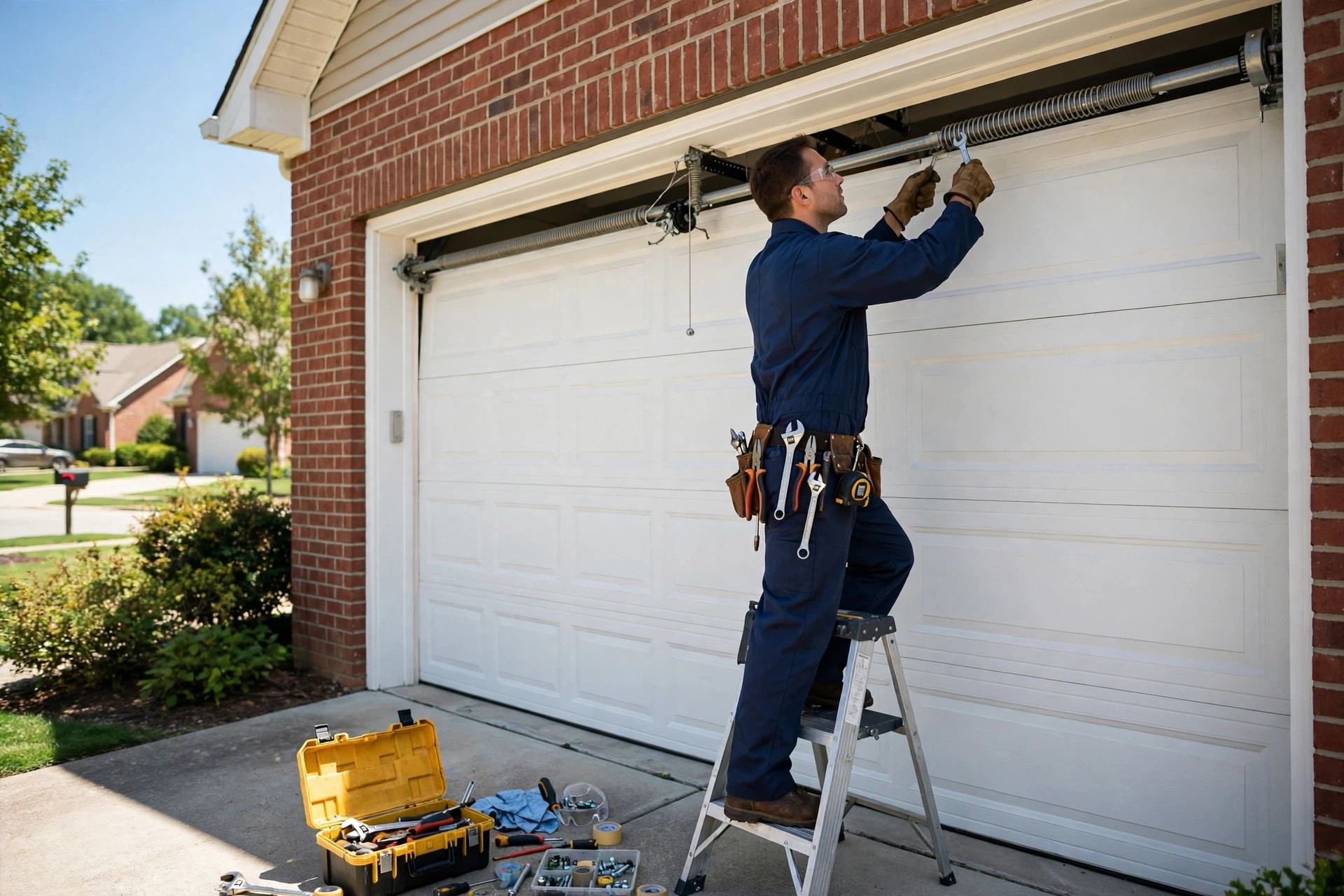
The one rule that governs everything below: never try to lift, force, or keep running a door with a broken spring, and never touch the spring itself. Springs store the energy of the door's full weight, and the replacement is a same-day professional job — $120-$350 for most residential doors — that includes rebalancing the door and recalibrating the opener. Everything in this guide is arranged so you can tell the dispatcher exactly what happened, get the right parts on the first truck, and avoid the one expensive mistake, which is turning a broken spring into a broken door.
In This Guide
- The Bang and the Gap: Confirming the Diagnosis
- What to Do in the First Ten Minutes
- Why Springs Break: Cycles, Rust and Wrong Sizing
- What a Spring Replacement Visit Actually Involves
- After the Fix: Getting the Full Life Out of the New Springs
- One Spring or Two? The Pair Question, Answered Honestly
- Torsion vs Extension: What Broke on Your Door
- The Trapped-Car Problem: Getting the Car Out Safely
Key Takeaways
- Start with your eyes, not your hands.
- Keep the door closed and leave it there.
- Springs do not break at random; they break on a counted schedule.
- The technician's first job is making the door safe, not fast.
- New springs earn their rating the same way old ones lost it: through the small habits.
- Every garage door with two springs raises the same question at replacement time, and the answer is the same every time: replace both.
- Knowing which system you have takes ten seconds and changes what you tell the dispatcher.
- The question every broken-spring call really asks is about the car, so here is the honest answer: tell the dispatcher the car is trapped, and the call is sequenced as a rescue.
How to use this guide: work the checks in the order given — they're sequenced from the most common and cheapest causes to the rarest and most involved, which is exactly how a technician's diagnosis proceeds. Stop at the step that solves it, and stop entirely at anything involving springs, cables or a door that's crooked or off its tracks: those are professional jobs, and this guide will tell you plainly when you've reached one. If you reach the end without a fix, call (210) 964-8892 and tell the dispatcher which steps you completed — you'll skip half the diagnosis and get the right parts on the first truck.
The Bang and the Gap: Confirming the Diagnosis
Start with your eyes, not your hands. Look at the spring shaft above the door: a torsion spring that has snapped shows a visible gap of a few inches in the coil — the spring in two pieces, sometimes with the broken ends curled away from each other. If you heard the bang, you will usually find the gap in the same minute. On an extension-spring door the signs are different: one side of the door hangs lower than the other, a cable hangs slack, or the spring itself is stretched out along the track instead of coiled tight.
The door's behavior confirms it. An opener that starts the lift, strains for a few inches, and stops is meeting the door's full dead weight and tripping its force sensor to protect itself. A door that will not budge at all when you try the wall button, while the opener hums or clicks, is the same story. Either way the diagnosis is made — stop running the opener. Every additional attempt strains the motor and the drive gear against a load they were never built to carry, and a burned-out opener turns a $120-$350 spring job into a spring job plus an opener.
What to Do in the First Ten Minutes
Keep the door closed and leave it there. Unplug the opener so nobody in the household can activate it by habit — a family member pressing the remote on a broken spring is the most common way a bad morning gets worse. If the door is stuck open, treat the garage as an open house: lock the interior door, move valuables out of sight, and say so when you call, because an unsecured home gets emergency priority. Do not pull the red release cord while the door is up: with the counterbalance gone, the cord is the only thing between the door and gravity.
Then call (210) 964-8892 and say three things: what you heard (the bang, and when), what you see (the gap in the coil, or one side hanging low), and whether the car is trapped inside. 'Car trapped' is the phrase that sequences the call as a rescue, and the dispatcher stocks the truck from your description — spring type, door size, single or double — so the first visit is usually the only visit. Photograph the spring and the door's position before anything moves; the photo helps the dispatcher and, if a vehicle was involved, any insurance question later.
Why Springs Break: Cycles, Rust and Wrong Sizing
Springs do not break at random; they break on a counted schedule. A standard torsion spring is rated for about 10,000 cycles — one cycle is one open and one close — which at four cycles a day is roughly seven years. A household that cycles the door eight times a day spends that rating in half the time, which is why a spring can fail on a door that 'isn't that old' by the calendar. High-cycle springs rated 20,000 or more exist for exactly this household, and the upgrade is usually $50-$100 on the job.
Rust is the second killer, and it works quietly for years before the snap. Moisture, road salt tracked into the garage, and coastal air pit the coil's surface, and each pit is a stress point where a crack starts. The third cause is sizing: a spring one size too light for the door's actual weight works at its limit from day one and dies young — a common finding on doors that gained weight over the years through insulation or a heavier replacement section. Cold snaps finish the job: steel gets less forgiving in deep cold, which is why January collects the springs that summer heat and autumn rust already spent.
What a Spring Replacement Visit Actually Involves
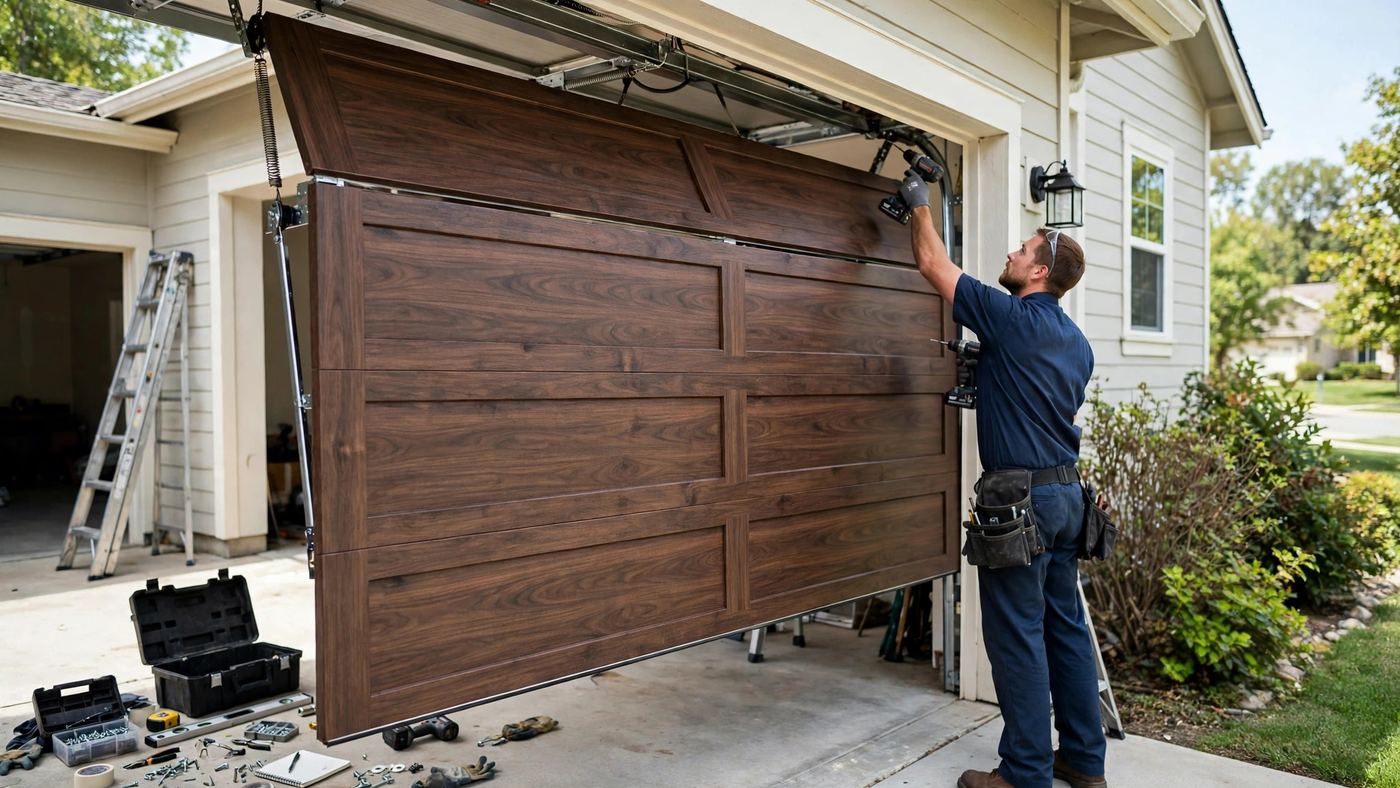
The technician's first job is making the door safe, not fast. The door is clamped in place, the remaining tension in the surviving spring is wound down with winding bars in controlled quarter-turns, and only then do the old springs come off the shaft. This is the part of the job that has no homeowner version: a wound torsion spring holds the door's full weight as stored energy, and the winding bars are the only safe way to release it. The whole operation takes one to two hours on a standard residential door.
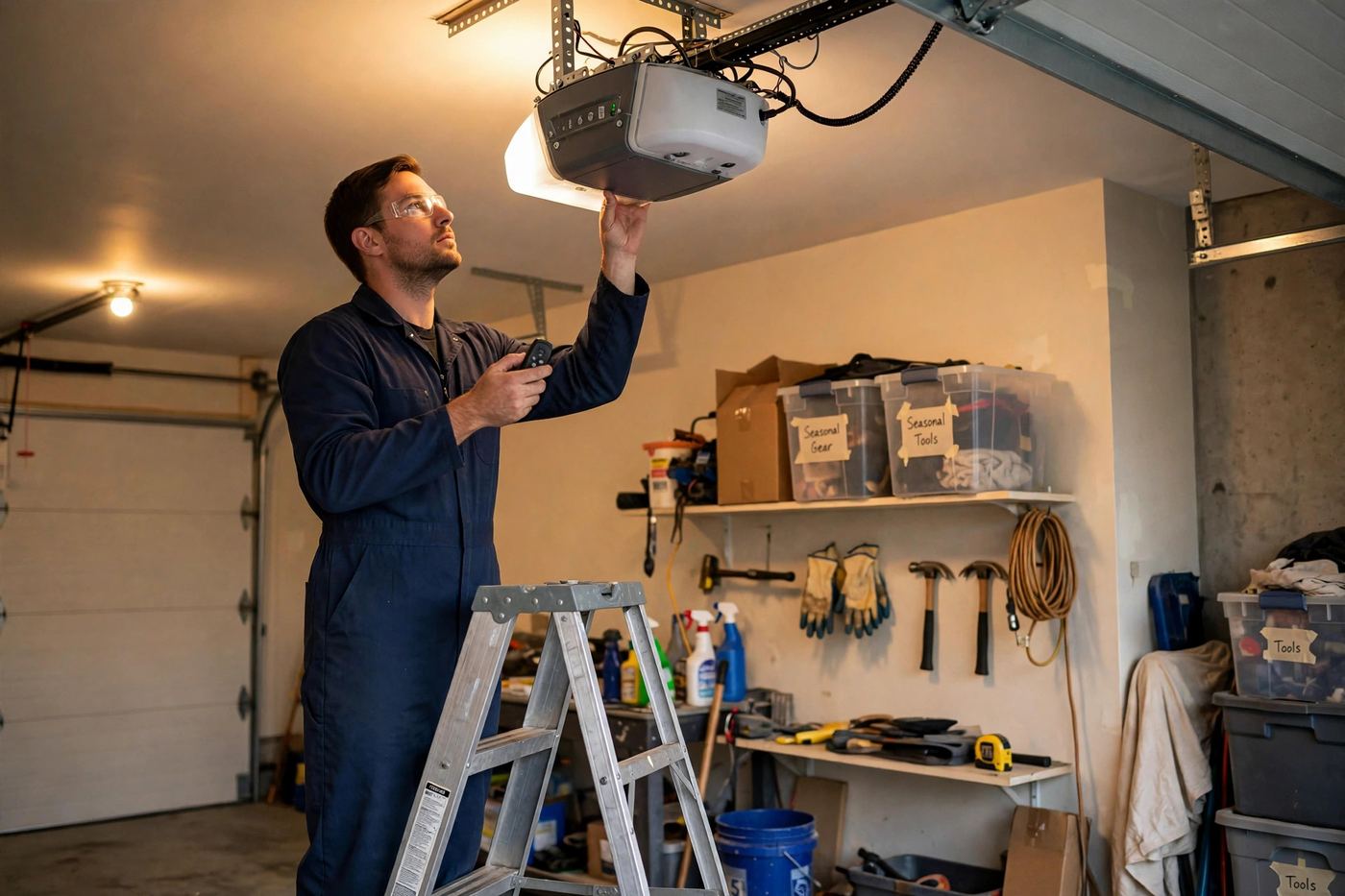
With the new springs on, the work is really about the system, not the part: the springs are wound to the door's weight, the door is balanced so it hovers at halfway when released, the cables are checked for fraying and re-seated on their drums, and the opener's travel and force settings are recalibrated to the balanced door. The safety systems are tested last — the photo-eye reversal and the contact-reverse test with a 2x4 — because a door that lifts correctly but cannot reverse correctly is not finished. A good visit ends with the technician showing you the balance test, so you can run it yourself every few months.
After the Fix: Getting the Full Life Out of the New Springs
New springs earn their rating the same way old ones lost it: through the small habits. Run the balance test quarterly — disconnect the opener with the door down, lift to halfway, let go: a balanced door stays put. A door that drifts down is telling you a spring is weakening months before it snaps, and that warning is worth a scheduled visit instead of a midnight one. Keep the coils lightly lubricated with a silicone or lithium garage-door spray twice a year, and wipe off any rust bloom the moment you spot it rather than the season after.
Two decisions at replacement time pay for themselves. The first is the matched pair (covered below): never replace one spring of a pair and leave its twin. The second is the cycle rating: if your household cycles the door hard — kids, a home office, a workshop — the high-cycle upgrade is the cheapest insurance in the whole garage, and it is the only upgrade that doubles a part's life for roughly the price of a dinner out. An annual tune-up ($75-$150) bundles all of this — balance, lubrication, cable and roller inspection — and it is the visit that turns spring replacement from an emergency into a line item you saw coming.
One Spring or Two? The Pair Question, Answered Honestly
Every garage door with two springs raises the same question at replacement time, and the answer is the same every time: replace both. The surviving spring has lived the same cycles, the same rust, the same road salt and the same winters as the one that broke — it is not a healthy spring that happened to be standing next to a broken one, it is a spring at the same age, months and sometimes weeks from the same failure. Replacing one spring buys a second emergency visit at after-hours rates, usually within the year, and the second visit costs more than the pair would have in the first.
There is a mechanical reason beyond the calendar: a matched pair lifts evenly. A new spring beside a tired one pulls its side of the door harder, the door rises crooked, the opener works unevenly, and the rollers wear one side of the track faster than the other. The pair is also how the door was engineered — the two springs are a single counterbalance system, not two independent parts. The only honest exception is a door that genuinely has one spring by design, which is common on light single doors; on a two-spring door, the pair is the job.
Torsion vs Extension: What Broke on Your Door
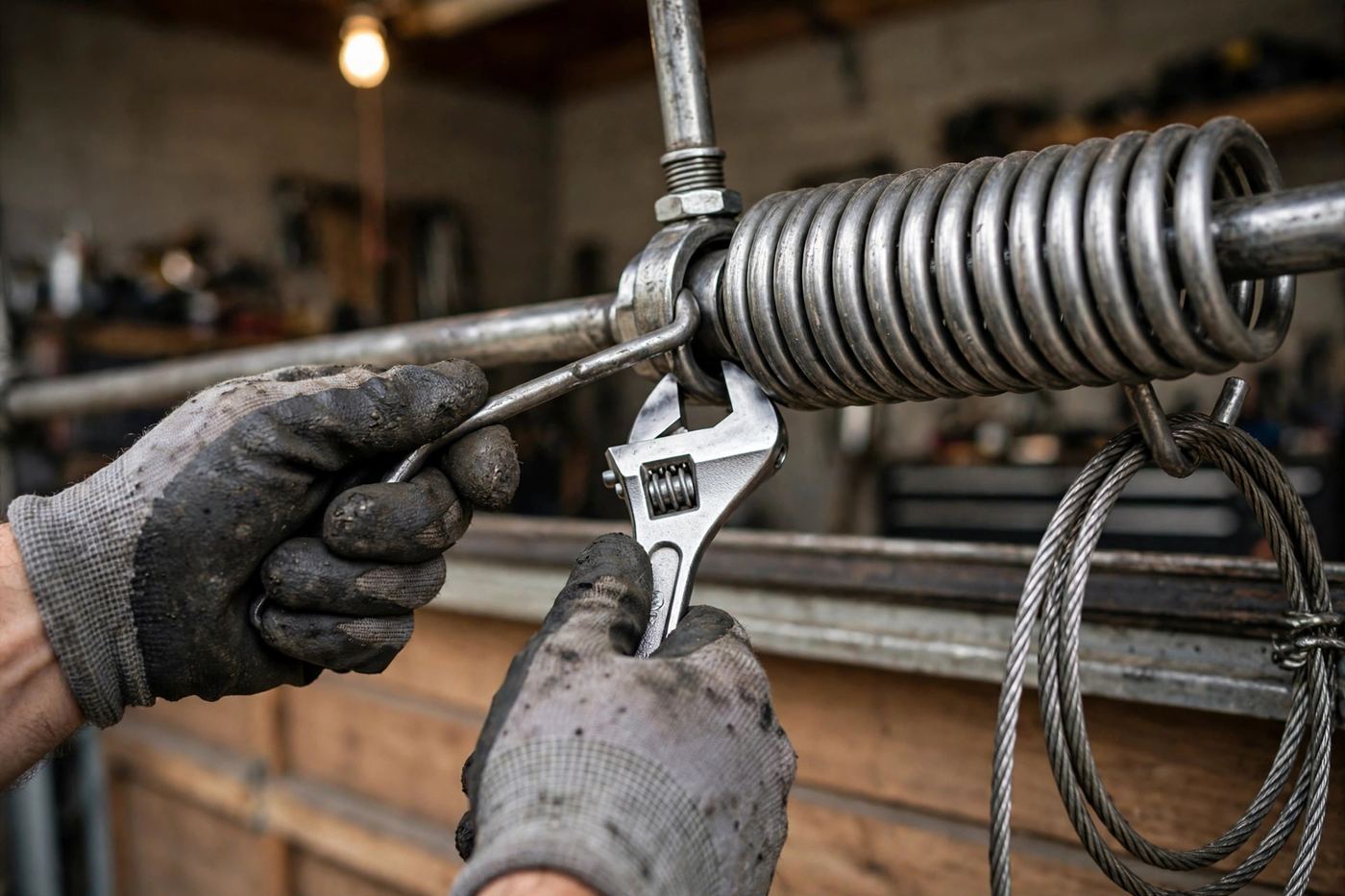
Knowing which system you have takes ten seconds and changes what you tell the dispatcher. A torsion spring sits on a shaft above the door, a thick coil you can see from inside the garage; when it breaks, the gap in the coil is the diagnosis. An extension spring runs alongside the horizontal track, stretching as the door closes; when it breaks, the door hangs crooked and a cable goes slack. The replacement prices differ — torsion pairs $200-$350, extension pairs $120-$280 — and so does the hardware the truck must carry, which is why the dispatcher asks.
Extension doors carry one extra question: the safety containment cable. A steel cable should run through the middle of each extension spring, so a breaking spring cannot whip across the garage; if yours has no containment cable, the replacement visit is the moment to fit one, and a door without it should be treated as unfinished. Torsion doors have their own conversion conversation: an extension setup can be converted to torsion for $300-$500 on most doors, and it is worth discussing when the door is heavy, the springs keep failing, or the tracks have room for the shaft — our torsion-versus-extension guide runs the full comparison.
The Trapped-Car Problem: Getting the Car Out Safely
The question every broken-spring call really asks is about the car, so here is the honest answer: tell the dispatcher the car is trapped, and the call is sequenced as a rescue. A technician can release the remaining spring tension in a controlled way, lift the door with the right equipment, and either complete the spring replacement in the same visit or secure the door so the car can come out and the repair can follow. The wait is usually measured in hours, not days, because spring replacement is standard same-day work and trapped-car calls jump the queue.
What not to do while you wait is the important half. Do not try to lift the door yourself: without its counterbalance it weighs its full 150-400 pounds, and a door lifted partway can drop without warning — that drop is how panels bend, tracks tear out of their brackets, and people get hurt. Do not ask a neighbor to help you muscle it, and do not run the opener 'just to get it up a little' — the opener will strain against the dead weight and can burn out its motor or strip its gear, adding an opener to a spring bill. If you have a second car, use it; if the appointment is tomorrow and the car must come out tonight, say so on the phone and the dispatcher will tell you honestly whether an emergency visit is the right call.
Broken Spring Reference (2026)
| Item | Cost / Rating | Notes |
|---|---|---|
| Torsion spring pair, installed | $200-$350 | The common case; includes balancing + opener recalibration |
| Extension spring pair, installed | $120-$280 | Includes safety containment cables |
| Spring + cable combo, one visit | $350-$650 | Whole lifting path renewed; worth it on doors over 10 years |
| High-cycle spring upgrade | +$50-$100 | Rated 20,000+ cycles; doubles spring life for a dinner out |
| Emergency / after-hours premium | $100-$300 | On top of the repair; trapped-car calls sequenced first |
| New opener (if the old one was damaged) | $350-$850 | Only when the opener strained itself to death on the dead door |
Frequently Asked Questions
Can I still use my garage door with a broken spring?
No — not safely, and not without making the repair bigger. Without counterbalance the door weighs its full 150-400 pounds; the opener will strain and can burn out its motor or strip its drive gear, and a manual lift risks the door dropping without warning. Keep the door closed, unplug the opener, and call for same-day spring replacement ($120-$350).
How much does it cost to replace a broken garage door spring?
Most residential jobs land at $120-$350, which covers the spring pair, labor, rebalancing and opener recalibration. Torsion pairs typically run $200-$350 and extension pairs $120-$280; a high-cycle upgrade adds about $50-$100. The after-hours premium, when it applies, is roughly $100-$300 on top.
How long does a spring replacement take?
One to two hours on a standard residential door, and it is standard same-day work when you call in the morning. The truck carries the common spring sizes, so the visit is usually diagnosis, replacement, balancing and safety testing in a single trip — the reason your description on the phone (spring type, door size, single or double) matters.
Why did my spring break now? It worked fine yesterday.
Springs fail at the end of a counted life, not on a schedule you can feel: about 10,000 cycles for a standard spring, shortened by rust, road salt, a spring sized light for the door, or a cold snap. The door works perfectly until the last cycle, because the steel gives no warning at the end — which is why the quarterly balance test matters more than any calendar guess.
Should I replace both springs if only one broke?
Yes. The surviving spring has lived the same cycles, the same rust and the same winters as the one that broke, and it is months — sometimes weeks — from the same failure. A matched pair also lifts evenly; a new spring paired with a tired one makes the door rise crooked and works the opener unevenly. Replacing the pair in one visit is cheaper than two emergency visits.
My door is stuck open with a broken spring. What do I do right now?
Leave it exactly as it sits, keep people and pets clear, and call (210) 964-8892 — a door stuck open is an unsecured home and gets emergency priority. Do not try to lower it by hand: without counterbalance it can drop, and a falling door damages tracks, sections and anything underneath. A technician secures it, controls the remaining spring tension, and either closes it safely or completes the spring replacement in the same visit.
Related Services
Broken Spring Replacement
Snapped torsion or extension spring? We replace springs in matched pairs, sized exactly to your door's weight — same-day.
Learn more about broken spring replacement →Garage Door Repair
Complete diagnosis and repair for doors that won't open, close, balance or seal — most repairs finished in a single visit.
Learn more about garage door repair →Emergency Garage Door Repair
Door stuck open at midnight, car trapped before work, spring snapped with a bang — 24/7 emergency crews, day or night.
Learn more about emergency garage door repair →← All garage door guides · Costs & pricing hub
Garage Door Stuck? We Can Fix It Today.
Same-day appointments and 24/7 emergency service across all 53 of our service cities. Upfront price before work starts — no surprises on the invoice.
(210) 964-8892 ☎ Call Now — Open 24/7