This guide is the fall routine that prevents it: what to inspect, lubricate, seal and test before the cold sets in, what each step costs in money and minutes, and which items belong to a professional tune-up. Most of it is an hour of your time and under $50 in supplies. The rest is one scheduled visit in the calm season — instead of an emergency call in the peak one, at the same prices but on a worse day.
In This Guide
- Why Winter Breaks Doors: The Four Cold Mechanisms
- Seals and Weatherstripping: The Freeze Line
- Lubrication and Hardware: The Seasonal Pass
- Power, Batteries and the Opener's Winter Weaknesses
- What to Schedule Instead of DIY: The Fall Tune-Up
- Climate Notes From Our Ten States: Winter Isn't One Season
- The January Emergency, Avoided: Three Fall Decisions
- Spring's Other Side: The Post-Winter Check
Key Takeaways
- Springs first.
- Start where the door meets the world.
- Lubricate the moving metal: hinges, roller stems and bearings, and the springs themselves (a light wipe of garage-door lubricant along the coils).
- Replace the remote and keypad batteries before the season, on the same schedule as the smoke detectors, and keep the spares somewhere warm.
- The division of labor is the same one this site draws everywhere.
- Our service map winters very differently, and preparation should follow the local mechanism.
- Three decisions made in October decide most January outcomes.
- Winter preparation has a mirror image that most checklists skip: the early-spring review, when you find out what the season actually spent.
How to use this guide: work the checks in the order given — they're sequenced from the most common and cheapest causes to the rarest and most involved, which is exactly how a technician's diagnosis proceeds. Stop at the step that solves it, and stop entirely at anything involving springs, cables or a door that's crooked or off its tracks: those are professional jobs, and this guide will tell you plainly when you've reached one. If you reach the end without a fix, call (210) 964-8892 and tell the dispatcher which steps you completed — you'll skip half the diagnosis and get the right parts on the first truck.
Why Winter Breaks Doors: The Four Cold Mechanisms
Springs first. Steel loses a measure of its toughness in deep cold, and a spring already at 9,800 of its 10,000 cycles faces peak season with holiday cycle counts (guests, deliveries, doors used as the main entrance in the cold) stacked on top. The January spring spike is metallurgy plus arithmetic. Second: lubricant. Old grease and the wrong lubricant thicken as temperatures drop, adding drag the opener reads as resistance — doors that reverse 'for no reason' in January are often just stiff.
Third: the bottom seal. A hardened or cracked seal bonds to a wet slab and freezes; the opener then pulls against ice, strains, and either reverses or tears the seal free — damaging the retainer in the process. Fourth: batteries. Remote batteries, keypad batteries and opener backup batteries all lose capacity in the cold, so the season's weakest-link failures cluster. Every item in the checklist below maps to one of these four mechanisms; there is no filler on the list.
Seals and Weatherstripping: The Freeze Line
Start where the door meets the world. The bottom seal should be soft, continuous and compressible along its whole length — press it with a thumb every foot or so. Hard, cracked or flattened sections are replacement items, and they're cheap: a bottom seal is a modest part, and replacing it before the freeze is a driveway job in mild weather and a miserable one in January. While you're there, clear the slab edge where the seal lands: gravel, ice chunks and built-up grit all break the seal line and give meltwater a path in to freeze.
Then the perimeter: side and top weatherstripping should close the visible light gaps when the door is shut on a bright day — stand inside, lights off, and look for daylight. Air leaks at the perimeter bypass even an insulated door, and they're also where wind-driven snow enters. Fresh perimeter seals and a sound bottom seal together are the difference between a garage that holds a few degrees of protection and one that tracks the outside temperature exactly — which is also the difference for everything stored in it, from paint to the car's battery.
Lubrication and Hardware: The Seasonal Pass
Lubricate the moving metal: hinges, roller stems and bearings, and the springs themselves (a light wipe of garage-door lubricant along the coils). Use a silicone or lithium garage-door lubricant — never grease, which collects grit and thickens in the cold, and never WD-40 as the lubricant itself (it's a solvent; it can clean a part before the real lubricant goes on). Rollers should spin freely by hand with the door disconnected; a roller that drags in October locks in January.
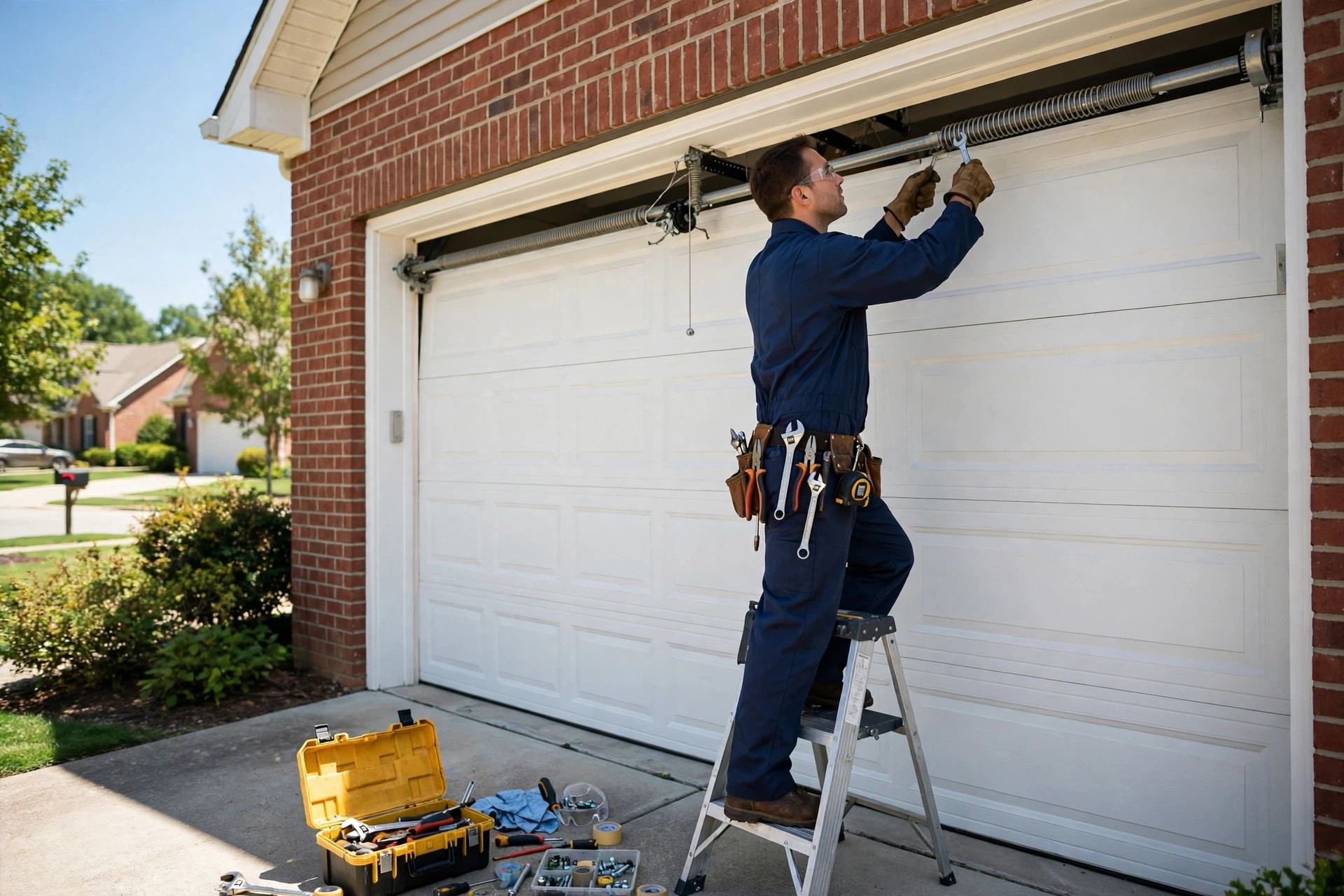
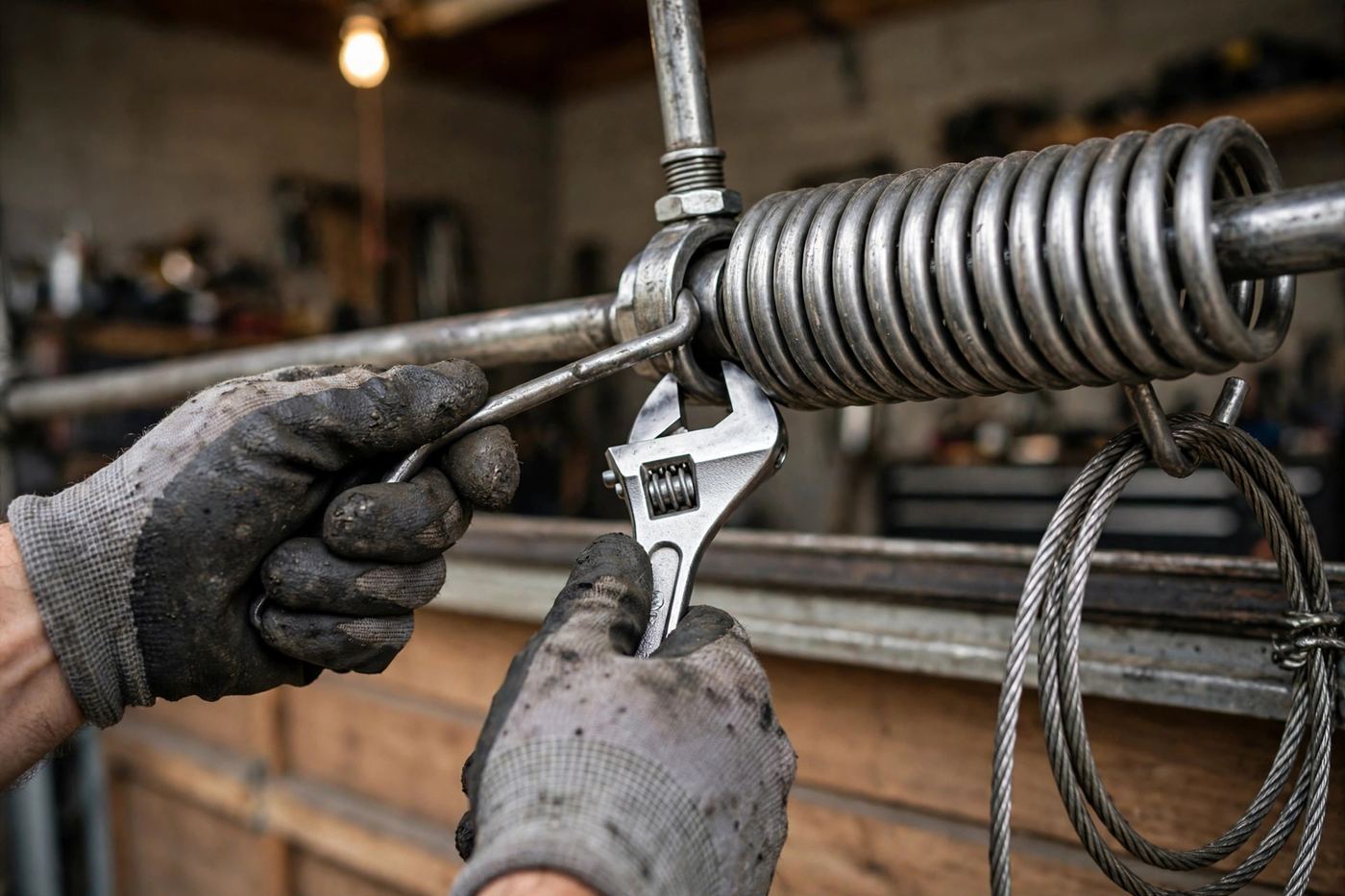
Hardware next: hinge bolts and track brackets vibrate loose over thousands of cycles, so a wrench pass in the fall tightens the system before winter's strain. Check the cables with the ten-second rule (fraying strands, rust, one looser than its twin) and look at the spring coils for rust blooms — both are scheduling signals, not cosmetics: they tell you whether this winter's spring and cable work can be planned in the calm weeks or whether it will choose its own morning. Anything under tension gets observed, never touched.
Power, Batteries and the Opener's Winter Weaknesses
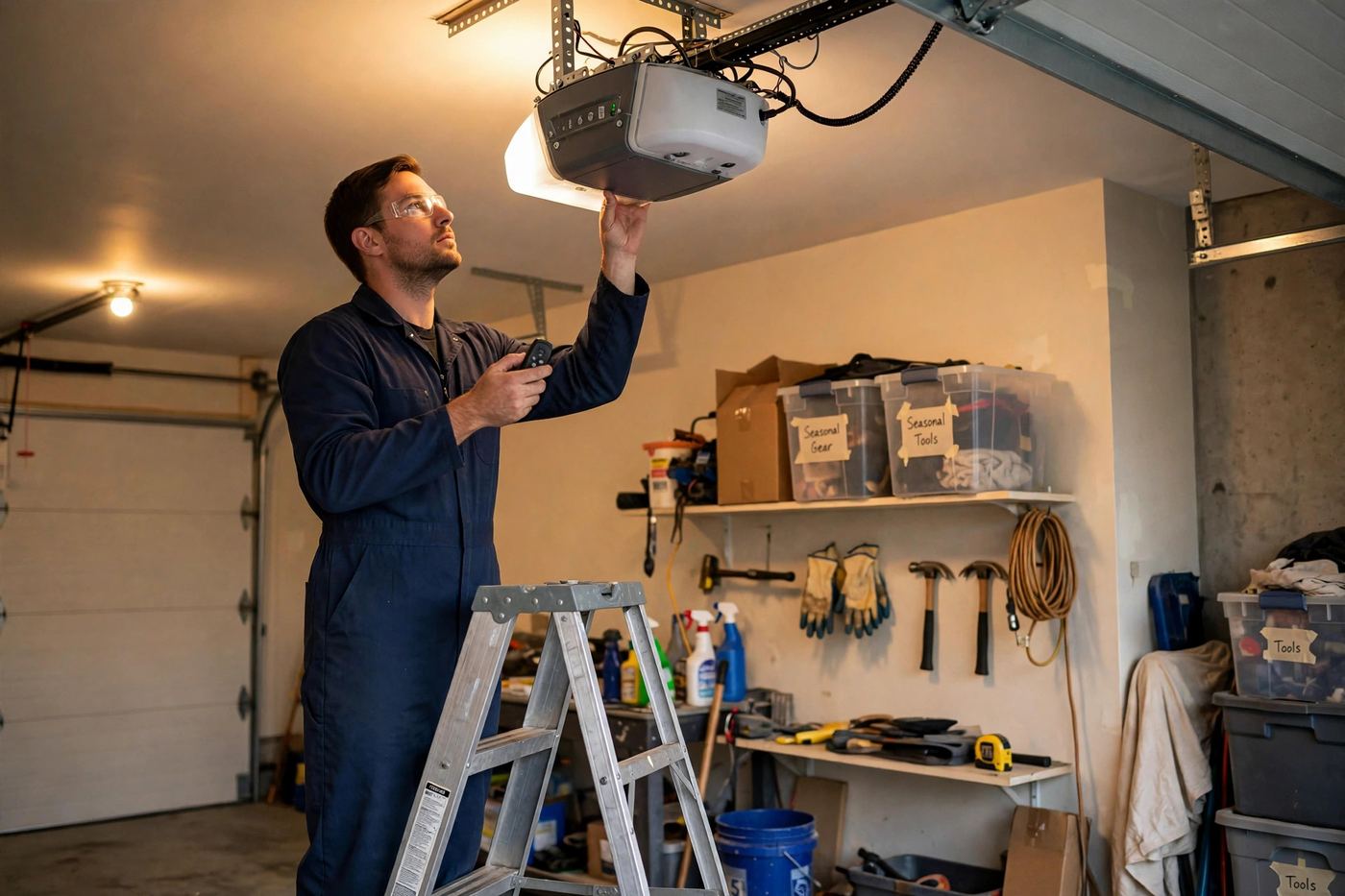
Replace the remote and keypad batteries before the season, on the same schedule as the smoke detectors, and keep the spares somewhere warm. If your opener has battery backup, test it: kill the power at the breaker and run the door on backup once. A backup battery that has never been tested is a hope, not a system — and winter outages are precisely when it's asked to perform, usually with a car on the wrong side of the door.
Cold also changes the opener's force equation: a stiff, cold door needs more force to move, and an opener whose force settings were marginal in summer may reverse or strain in January. The correct fix is almost never 'turn the force up' — it's removing the stiffness (lubrication, seal condition, balance) so the settings stay honest. And run the balance test while you're at it: disconnect the opener, lift the door halfway by hand, and let go. A balanced door hovers. One that drifts is telling you the spring math has changed, in the one season when you most want to know early.
What to Schedule Instead of DIY: The Fall Tune-Up
The division of labor is the same one this site draws everywhere. Yours: seals, lubrication of accessible pivots, batteries, visual cable and spring inspection, the balance and safety tests. A technician's: spring tension adjustment or replacement, cable replacement, drum and bearing work, opener force calibration at the board level, and anything requiring the door to come apart. A professional fall tune-up runs $75-$150 and covers the pro half plus a full inspection of yours, with the findings in writing.
The scheduling logic is the final item on the checklist: book it in fall. The same companies that can offer you a choice of days in October are triaging emergencies in January, when a tired spring doesn't ask your calendar's permission. If the inspection finds a spring in its final season, replacing it on a planned fall visit costs the same $120-$350 band as the emergency version — same spring, same price range, better day, and your pick of appointment times. Winter preparation, in the end, is mostly the art of moving January's decisions into October.
Climate Notes From Our Ten States: Winter Isn't One Season
Our service map winters very differently, and preparation should follow the local mechanism. New England and the Midwest (Massachusetts, Connecticut, Rhode Island, Indiana, Kansas, Missouri): the full checklist applies — freeze bonding, road salt on cables and bottom sections, deep-cold spring risk. The mid-South (Tennessee, Georgia): the killers are freeze-thaw cycling and seals that bond during the handful of hard freezes, plus storm-season surges; the fall pass emphasizes seals, balance and the opener's surge protection. Texas: winter is episodic but real — the rare hard freeze snaps the springs that summer heat already spent, so the spring-and-cable inspection matters more than the weatherstripping. Coastal California: no freeze at all — the winter job there is corrosion watch and storm readiness, cables and springs inspected for the salt-air wear that works year-round.
The point of the regional read: 'winter preparation' is really 'extreme-season preparation.' Every region has a season that collects the door's debts; the checklist is the same, the emphasis is local. When you book a fall tune-up, the technician's inspection order should reflect your state's version — and if it doesn't, that's a fair question to ask.
The January Emergency, Avoided: Three Fall Decisions
Three decisions made in October decide most January outcomes. First, the spring verdict: a spring showing stretch, rust or age past its rating gets replaced on a scheduled visit — the single highest-value decision on this page, because spring failure is the January emergency that traps cars. Second, the seal decision: a bottom seal that's hard in October is a frozen bond in January; seals are cheap and the swap is pleasant in fall weather. Third, the battery decision: remotes, keypad and the opener's backup tested and renewed before the outage season, not discovered during it.
Notice what these share: each is cheap, each is schedulable, and each converts an emergency into an appointment at the same price band. Winter preparation isn't really a checklist — it's a calendar argument. The door will spend its maintenance money either way; fall is simply when you get to choose the day.
Spring's Other Side: The Post-Winter Check
Winter preparation has a mirror image that most checklists skip: the early-spring review, when you find out what the season actually spent. Springs that survived January have still spent their hardest cycles; cables that carried road salt all winter show their rust now, at the brackets, where it's easiest to see; seals that froze twice have taken their set and may no longer spring back. Fifteen minutes in March catches all of it at the inspection stage instead of the failure stage.
The spring review is also when the year's decisions are cheapest to make. A spring system condemned by the check gets replaced in the industry's calm shoulder season — easiest scheduling of the year. The opener gets its force and travel verified after a winter of stiff travel, before summer heat starts its own argument with the electronics. And the maintenance log — fall prep dates, winter incidents, spring findings — quietly becomes the document that prices your door's future: every subsequent technician starts from evidence instead of from zero.
Treat the two seasonal passes as one habit with two dates. The households that run them are the ones whose doors reach their third decade boringly — and boring, in garage door ownership, is the entire goal.
Winter Prep: Costs & Timing
| Item | Cost / Rating | Notes |
|---|---|---|
| Bottom seal replacement | $50-$150 typical | Fall — before the first freeze bond |
| Perimeter weatherstripping | Modest parts + an hour | Fall; check by the daylight test |
| Lubricant (garage-door rated) | Under $15 | Seasonal; never grease or WD-40 alone |
| Batteries (remote/keypad/backup test) | A few dollars | Fall; put on the smoke-detector schedule |
| Professional fall tune-up | $75-$150 | Fall; includes inspection + safety tests |
| Planned spring replacement | $120-$350 | Same band as January's emergency version |
Frequently Asked Questions
When should I winterize my garage door?
In the fall, before the first hard freeze — October in most northern states. The work assumes mild-weather access (seals and lubricant behave better warm), and any spring or cable the inspection condemns can be replaced on a calm schedule instead of during the January emergency peak.
What lubricant should I use on my garage door in winter?
A silicone or lithium-based garage-door lubricant on hinges, roller stems and bearings, plus a light wipe on the springs. Never grease — it collects grit and thickens in the cold — and don't use WD-40 as the lubricant itself; it's a solvent cleaner, not a lasting lubricant.
Why does my garage door reverse or struggle in cold weather?
Usually stiffness, not failure: thickened old lubricant, a bottom seal frozen or bonded to the slab, contracted tracks, or a marginal spring finally too weak in the cold. Remove the stiffness — seals, lubrication, balance — rather than turning the opener's force up, which masks the cause and wears the opener.
How much does a professional winter tune-up cost?
Typically $75-$150 for a full inspection and tune-up: springs and cables checked, hardware torqued, lubrication, balance set, and both safety tests run. If the visit finds a spring in its final season, replacing it then is the same $120-$350 band as the January emergency version — just on a better day.
Does cold weather really break garage door springs?
Yes — it's metallurgy plus usage. Cold reduces spring steel's toughness, lubricants thicken so the system works harder, and holiday use raises cycle counts. A spring near the end of its rated cycles in fall is statistically likely to finish the count on the coldest, busiest mornings of the year.
My garage door froze to the ground. What do I do?
Don't force it with the opener — you'll tear the seal or strain the opener. Break the ice bond gently: warm water along the seal line or careful prying of the seal (never the door sections), then lift manually once free to confirm. Replace the seal and check for slab-edge pooling afterward; the bond happened because water sat where the seal lands.
Related Services
Garage Door Maintenance & Tune-Up
A full tune-up: balance test, lubrication, hardware tightening, sensor and safety checks — the cheapest way to avoid a breakdown.
Learn more about garage door maintenance & tune-up →Broken Spring Replacement
Snapped torsion or extension spring? We replace springs in matched pairs, sized exactly to your door's weight — same-day.
Learn more about broken spring replacement →Garage Door Repair
Complete diagnosis and repair for doors that won't open, close, balance or seal — most repairs finished in a single visit.
Learn more about garage door repair →← All garage door guides · Costs & pricing hub
Garage Door Stuck? We Can Fix It Today.
Same-day appointments and 24/7 emergency service across all 50 of our service cities. Upfront price before work starts — no surprises on the invoice.
(210) 964-8892 ☎ Call Now — Open 24/7