This guide prices panel replacement by door style and by material from published 2026 data, explains the matching problem honestly — including the sun-fade issue nobody warns you about — and runs the math for the real decision: one panel, two panels, or the whole door.
In This Guide
- What a Panel Replacement Actually Involves
- Cost by Door Style
- Cost by Material — and Where the Panel Itself Lands
- The Matching Problem: Discontinued Models and Sun Fade
- One Panel, Two Panels, or a New Door: The Math
- Reading a Panel Quote: What Should Be Itemized
- Insurance and Impact Damage: Documenting a Panel Claim
- Protecting the Panels You're Keeping
Key Takeaways
- A 'panel' is one horizontal section of your door — most doors have four to six.
- Style drives panel pricing more than size does, because styles differ in how their sections are made and matched.
- The section itself runs $150-$800 before labor.
- Two matching risks decide more panel jobs than price does.
- The governing rule is the same one this site applies to every repair-versus-replace question: when the repair approaches half the cost of replacement, replacement starts winning — because the repair buys time on an asset that's still aging toward the same replacement.
- A panel quote you can trust names: the door's make and model as identified on site, the section position (bottom, second, top), the section's specification — material, insulation, finish/color code — the labor, and the hardware scope (hinges, rollers, brackets inspected or replaced).
- When a vehicle meets a door, two policies sometimes have views: homeowners (the door is part of the dwelling) and auto (the vehicle's liability).
- A panel replacement usually happens on a door whose other sections have years left — and those years depend on unglamorous care.
How to use this guide: find your situation in the tables, note the fair range, then compare it line by line with any quote you receive — including ours. If a number falls outside the ranges here, the right response isn't panic; it's one question: 'what's different about my door?' A good company answers it in specifics — door weight, part specification, timing — and a vague answer is itself the answer. When you're ready for an exact figure, call (210) 964-8892: our quotes are flat, written from the same data as this guide, and confirmed before any work begins.
What a Panel Replacement Actually Involves
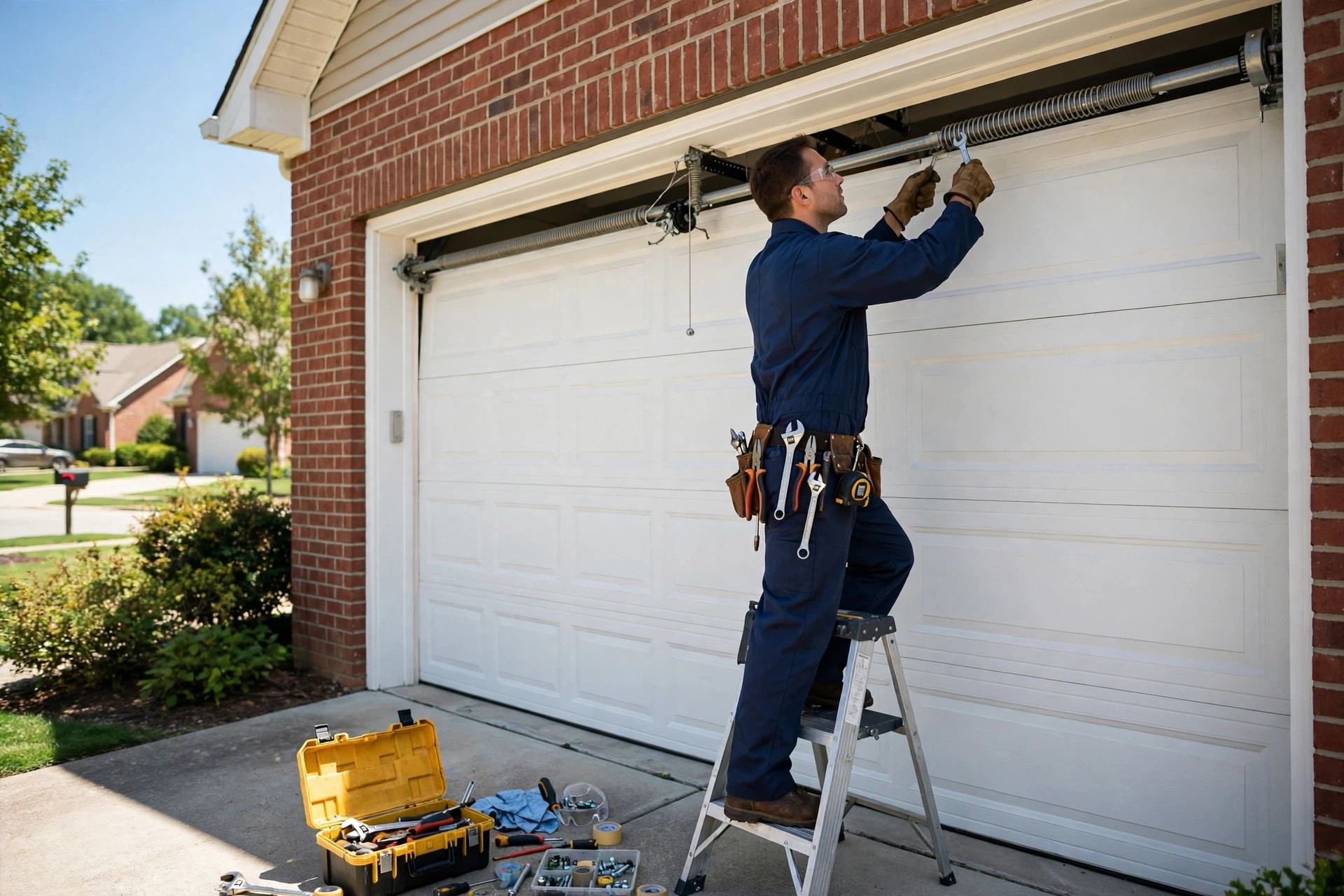
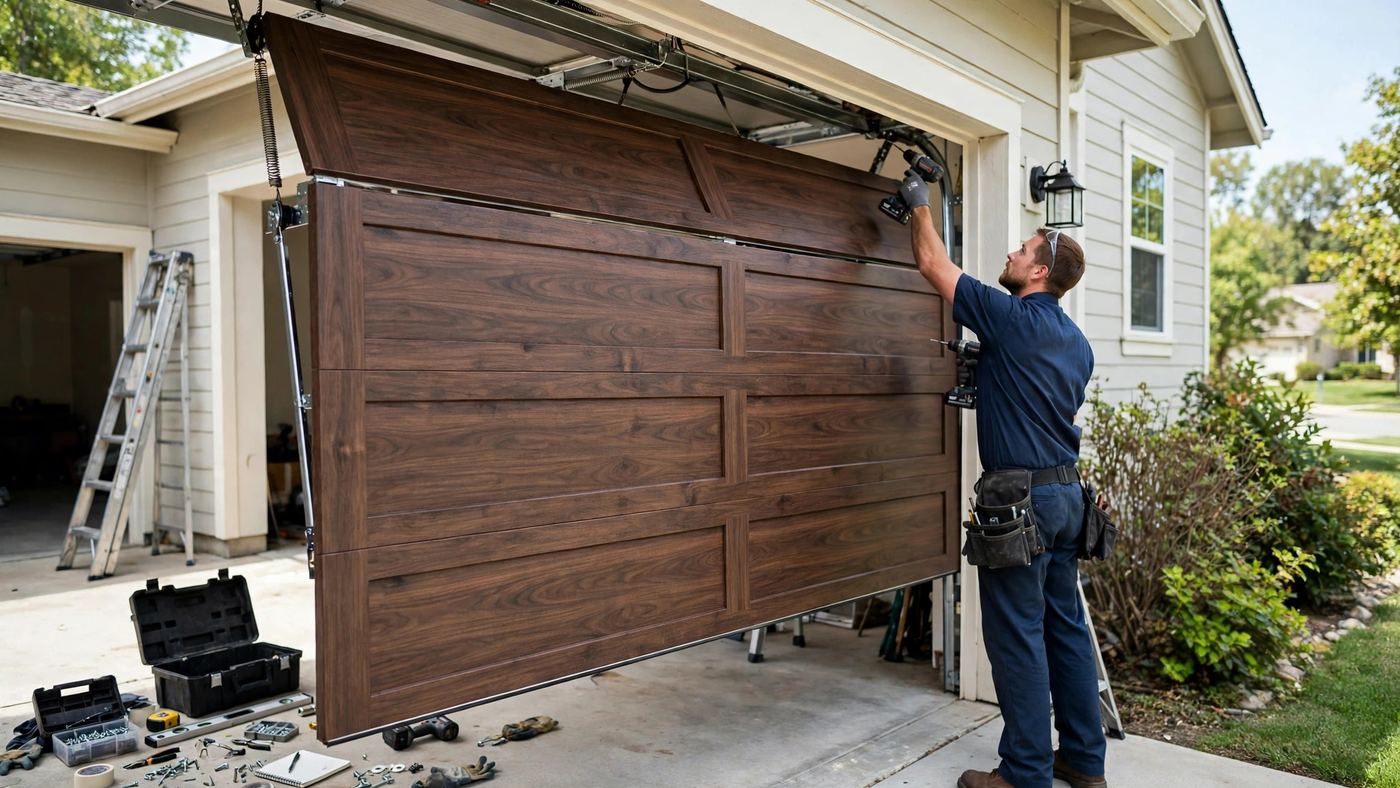
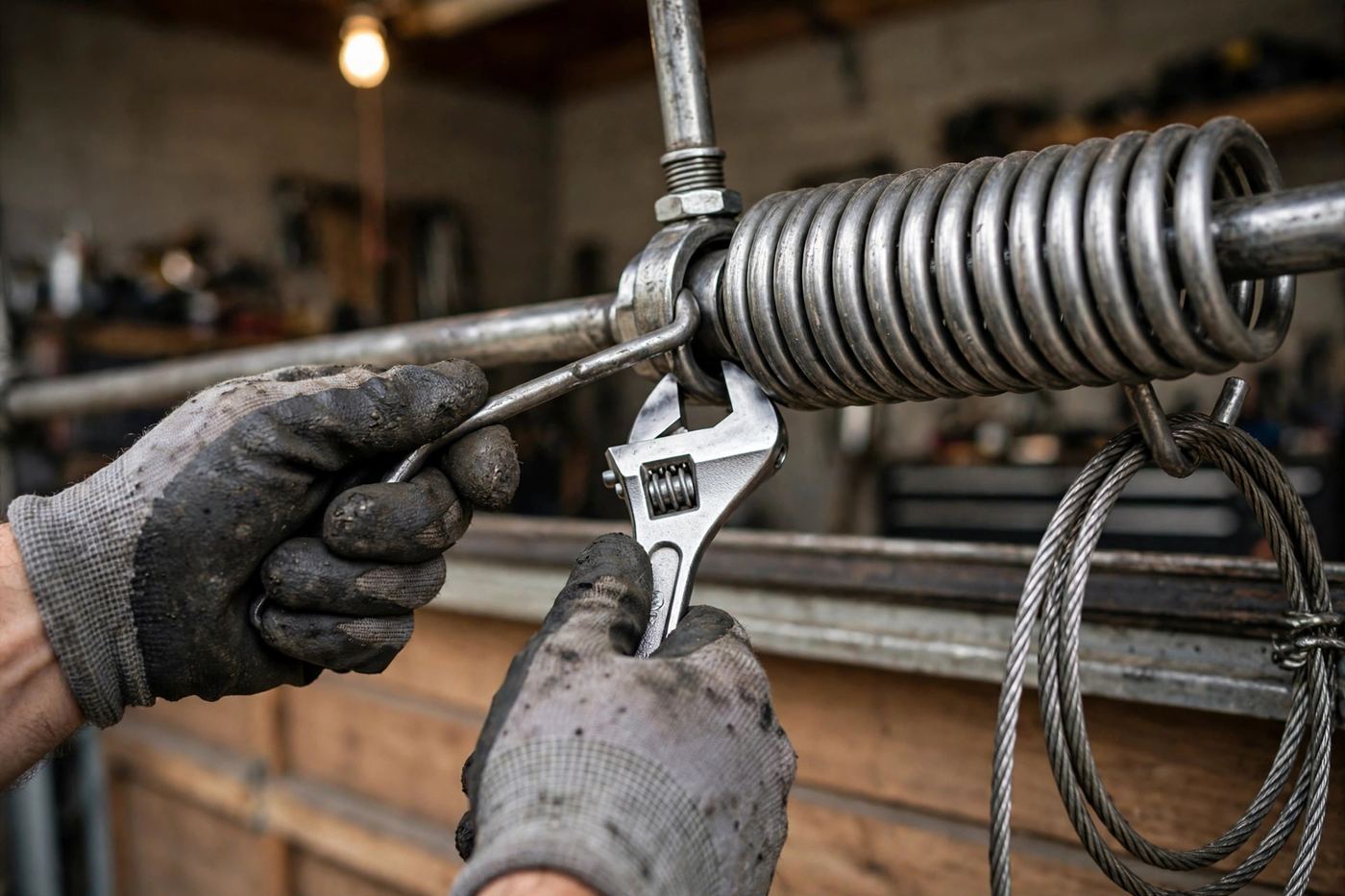
A 'panel' is one horizontal section of your door — most doors have four to six. Replacing one is not like swapping a picture frame: the door comes apart section by section under controlled spring tension, the damaged section comes out, the new section seats into the hinge line, and the whole door is rebalanced and safety-tested. That's why labor runs $200-$500 and typically accounts for roughly half the invoice on a standard job — one to two hours for a single section, three to four when multiple sections are involved.
Position matters too. The bottom section is the most commonly damaged (it's the one bumpers meet) and the most weather-exposed, often carrying the bottom seal and retainer in the same job. Top sections involve the opener's attachment point and the strut that stiffens wide doors. A quote that identifies the section by position and names the door's make and model is a quote from someone who has actually specced the job — which is the first thing to verify, because everything else in this guide depends on the section being available at all.
Cost by Door Style
Style drives panel pricing more than size does, because styles differ in how their sections are made and matched. Sectional doors — the common four-to-six-panel design — are the cheapest to repair this way, at $250-$500 per section installed. Roll-up doors run $150-$400 per section; their sections are simpler, though the labor can be intensive. Tilt-up doors (the single-piece swing-up design on older homes) run $400-$1,900, because the 'panel' is effectively the door's face. Side-sliding and side-hinged designs span the widest range, $250-$3,000, reflecting how custom their sections tend to be.
Read those ranges with the availability rule in mind: the figures assume your section is identifiable and in production. A standard sectional from a major maker (Clopay, Amarr, Wayne Dalton, CHI) is a catalog order. An orphaned model — a door from a discontinued line or a defunct regional maker — is where tilt-up and custom numbers come from, and where the panel-versus-door decision often gets made for you.
Cost by Material — and Where the Panel Itself Lands
The section itself runs $150-$800 before labor. Steel sections sit at $300-$600 for part and labor combined in typical cases — the market's center of gravity, available in the widest range of styles. Wood sections run $400-$800: the material costs more, and matching a wood door's species and finish is craft work. Aluminum-and-glass (full-view) sections run $400-$1,000 or more; the frames and glazing are specialty items. Insulated sections cost more than single-layer ones in every material, because there's simply more section to buy.
Two cost adders surprise owners. First, impact damage rarely stops at the section: the same bumper tap that bent the panel often bends a track, snaps a roller bracket or stresses the hinges, adding $150-$550 in accompanying hardware when a full inspection is done honestly. Second, finish matching: a factory-primed section needs paint; a factory-finished section needs the right color code. Neither is expensive alone, but both belong in the written quote — 'panel replacement' with no mention of finish or hardware scope is an incomplete number.
The Matching Problem: Discontinued Models and Sun Fade
Two matching risks decide more panel jobs than price does. The first is production: sections are model-specific. The profile, the embossing depth, the tongue-and-groove joint between sections, even the hinge spacing must match your door exactly, or the new section won't seat and seal. If your door's model line is discontinued, a true match may simply not exist — and a near-match that doesn't seal is worse than an honest conversation about a new door.
The second risk is color. Even with the exact model and color code, a door that has sat in the sun for five to ten years has faded one to two shades; the new section arrives at the original color and reads visibly brighter or darker than its neighbors. It weathers toward a match over a season or two, but owners should hear about it before the install, not after. Practical mitigations: painting the full door after a panel swap (which also refreshes the whole face), or — when two or more sections are involved — pricing the full door, because the labor curve is about to make that decision for you anyway.
One Panel, Two Panels, or a New Door: The Math
The governing rule is the same one this site applies to every repair-versus-replace question: when the repair approaches half the cost of replacement, replacement starts winning — because the repair buys time on an asset that's still aging toward the same replacement. Panel work sharpens the rule. One section at $250-$800 on a sound door with years of life left is excellent money. Two sections stack labor to 60-80% of a full door replacement while leaving you with the old door's remaining sections, springs and wear — the classic bad deal in this category.
Replace the door instead when: two or more sections are damaged; the door is past 10-15 years with other wear arriving; sections are discontinued; or rust and rot extend beyond the damaged panel (bottom sections on steel and wood doors especially). And remember what a new door's price includes in a proper quote — sections, tracks, springs sized to the door, cables, rollers and seals, installed at $550-$1,800 for most homes — which is why the crossover arrives sooner than owners expect. A technician who prices both paths in writing is giving you the decision the way it should be given.
Reading a Panel Quote: What Should Be Itemized
A panel quote you can trust names: the door's make and model as identified on site, the section position (bottom, second, top), the section's specification — material, insulation, finish/color code — the labor, and the hardware scope (hinges, rollers, brackets inspected or replaced). It should also state the sourcing lead time, because for anything beyond a current catalog section, the wait is part of the price of the decision. A single number with none of that named is a quote built to be renegotiated at install.
Ask the two questions that expose thin quotes. 'What happens if the section arrives and doesn't match?' — the answer reveals whether matching risk was assessed or assumed away. And 'what did the inspection find beyond the panel?' — because the impact that bent your section had opinions about tracks and brackets too, and a quote silent on them is a second invoice in waiting.
Insurance and Impact Damage: Documenting a Panel Claim
When a vehicle meets a door, two policies sometimes have views: homeowners (the door is part of the dwelling) and auto (the vehicle's liability). Either way, adjusters ask for the same evidence — dated photos of the damage before anything moves, and an itemized invoice separating the impact damage from any pre-existing wear. Take the photos yourself in the first ten minutes; they're the cheapest claim documentation that exists.
Sequence protects the claim: document first, then secure the opening, then repair. A door that's been reset and re-paneled before documentation is hard to claim after the fact, because the evidence was the damage. If you're unsure whether you'll claim, the photos cost nothing and the decision can be made later — but it can't be made retroactively.
Protecting the Panels You're Keeping
A panel replacement usually happens on a door whose other sections have years left — and those years depend on unglamorous care. The bottom section lives hardest: keep its seal supple and intact, clear the driveway edge so meltwater and rain don't pond against it, and touch up paint chips before rust gets a foothold in the steel. On the inside, the section joints collect grit; a yearly wipe-down keeps the pinch points moving freely. Sun works on the face over years, which is the fade your new section will weather toward — a coat of quality exterior paint across the whole door, when the time comes, re-unifies both protection and color in one job.
Driving habits are panel care too, and they're the cheapest line in this guide: the door isn't fully up until it's fully up — a surprising share of panel damage is a bumper meeting a door still traveling, or a roof rack meeting a door that stopped two inches short. Panels run $250-$800; patience runs four seconds. New drivers in the household get this briefing explicitly, the way they get the mirror talk.
After your new section is installed, expect a short settling period: run the door weekly and watch the new section's joints for even gaps, and re-check the bottom seal after the first hard rain. New sections settle microscopically into their hinges; if anything looks uneven in the first month, call — seating adjustments under warranty are quick, and they're how a replaced panel becomes an invisible one.
Panel Replacement by Style (2026, Installed)
| Item | Cost / Rating | Notes |
|---|---|---|
| Sectional (standard) | $250-$500 | The common case; catalog sections for major brands |
| Roll-up | $150-$400 | Simpler sections; labor can be intensive |
| Tilt-up (one-piece) | $400-$1,900 | The 'panel' is effectively the door's face |
| Side-sliding / side-hinged | $250-$3,000 | Often custom sections; widest range |
| By material: steel section | $300-$600 | Part + labor, typical totals |
| By material: wood / glass-aluminum | $400-$1,000+ | Craft matching; specialty glazing |
Frequently Asked Questions
How much does it cost to replace one garage door panel?
For most sectional doors, $250-$800 installed. The section itself runs $150-$800 depending on material and style, with labor at $200-$500. Steel sections typically total $300-$600; wood $400-$800; aluminum-and-glass $400-$1,000+. Tilt-up and custom doors can run higher.
Can any garage door panel be replaced individually?
Only if the section is identifiable and still in production, and the door's remaining sections are sound. Sections are model-specific — profile, joints and hinge spacing must match. Discontinued models are the common dead end, and they convert a panel job into a new-door conversation.
Will the new panel match the color of my door?
The model and color code will match; the shade may not, at first. Sun fades a door one to two shades over 5-10 years, so a new section can read brighter or darker until it weathers in. Painting the whole door after the swap is the clean fix, and worth discussing before the install.
Is it worth replacing two damaged panels?
Usually not. Labor for multi-section work reaches 60-80% of a full door replacement, while leaving the old door's other sections and hardware in place. At two damaged sections, price a new door — installed at $550-$1,800 for most homes — and compare honestly.
How long does a panel replacement take?
One to two hours for a single section once it's on site, and three to four for multiple sections. The clock before that is sourcing: a catalog section for a current model may take days; specialty and custom sections can take weeks, and your quote should state the lead time.
Can I replace just the bottom panel of my garage door?
Usually yes — the bottom section is the most commonly replaced and the most commonly stocked. It's also the most weather-exposed, so the same job often includes a fresh bottom seal. The conditions are the usual ones: the model must be identifiable, the section in production, and the rest of the door worth the investment.
Related Services
Garage Door Panel Replacement
Cracked, dented or rusted panel? We match and replace individual sections when the model allows — or give honest replacement math.
Learn more about garage door panel replacement →New Garage Door Installation
Full door replacement and new installs — steel, insulated, carriage-style and modern doors, measured, fitted and balanced.
Learn more about new garage door installation →Garage Door Repair
Complete diagnosis and repair for doors that won't open, close, balance or seal — most repairs finished in a single visit.
Learn more about garage door repair →← All garage door guides · Costs & pricing hub
Garage Door Stuck? We Can Fix It Today.
Same-day appointments and 24/7 emergency service across all 50 of our service cities. Upfront price before work starts — no surprises on the invoice.
(210) 964-8892 ☎ Call Now — Open 24/7