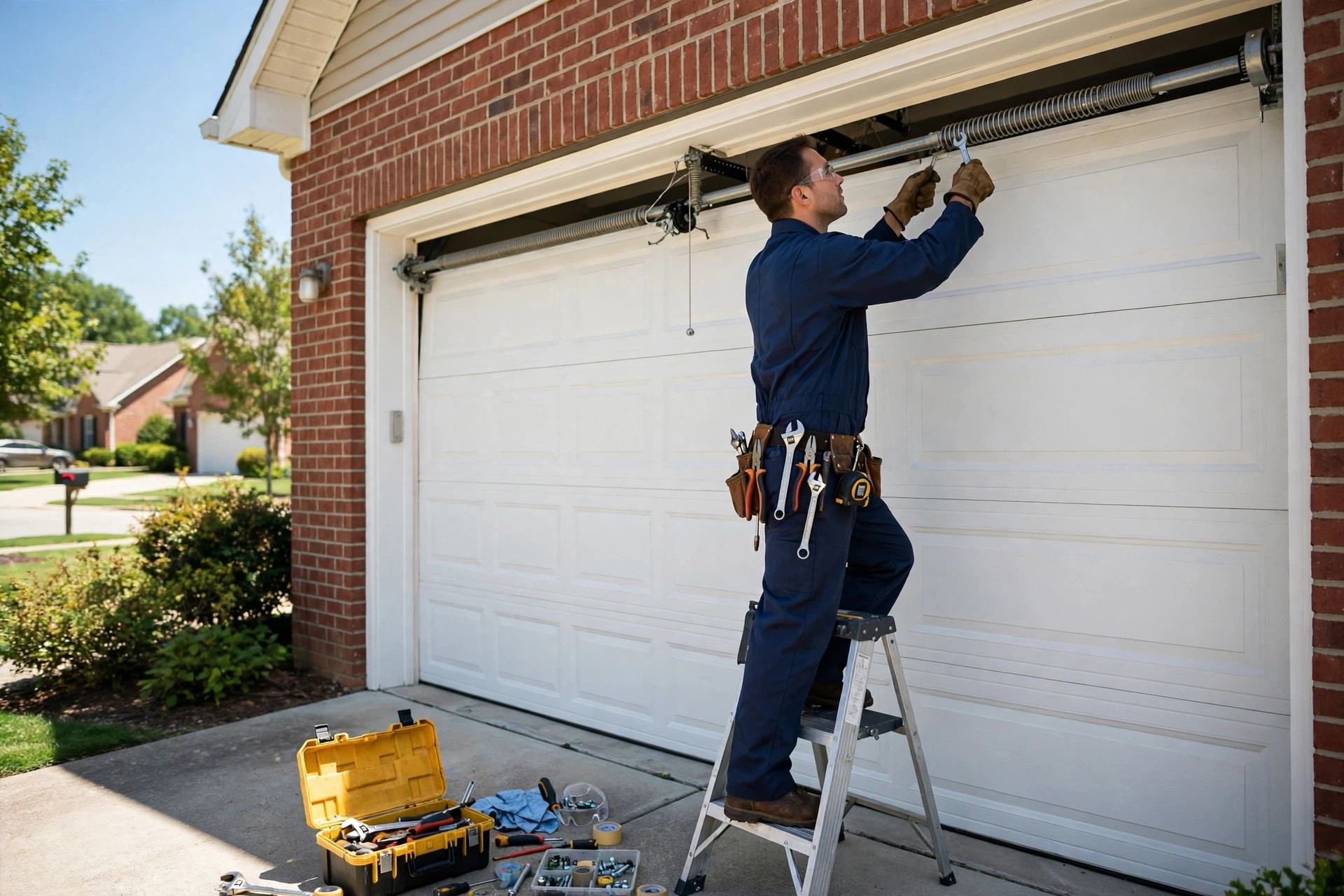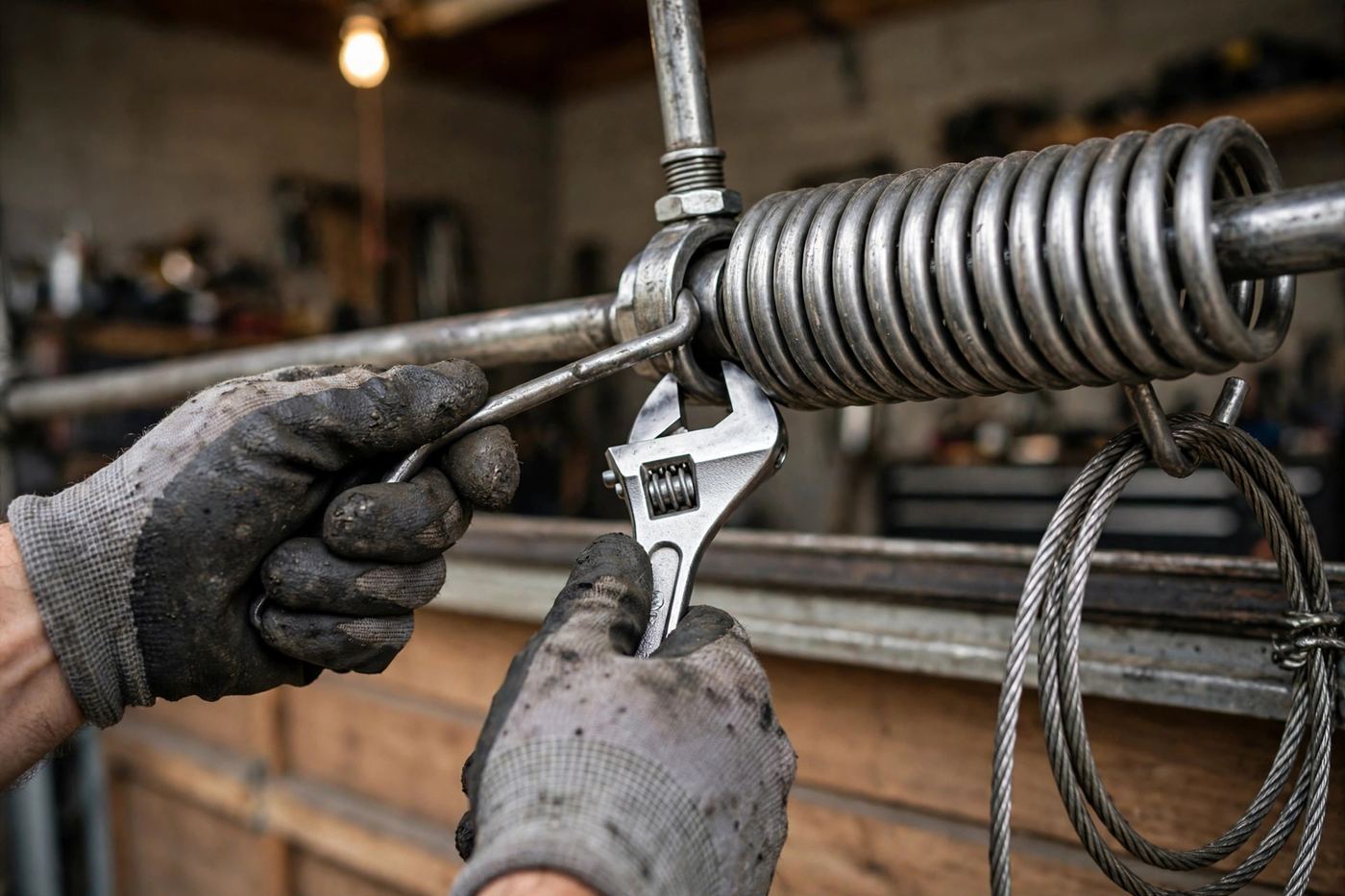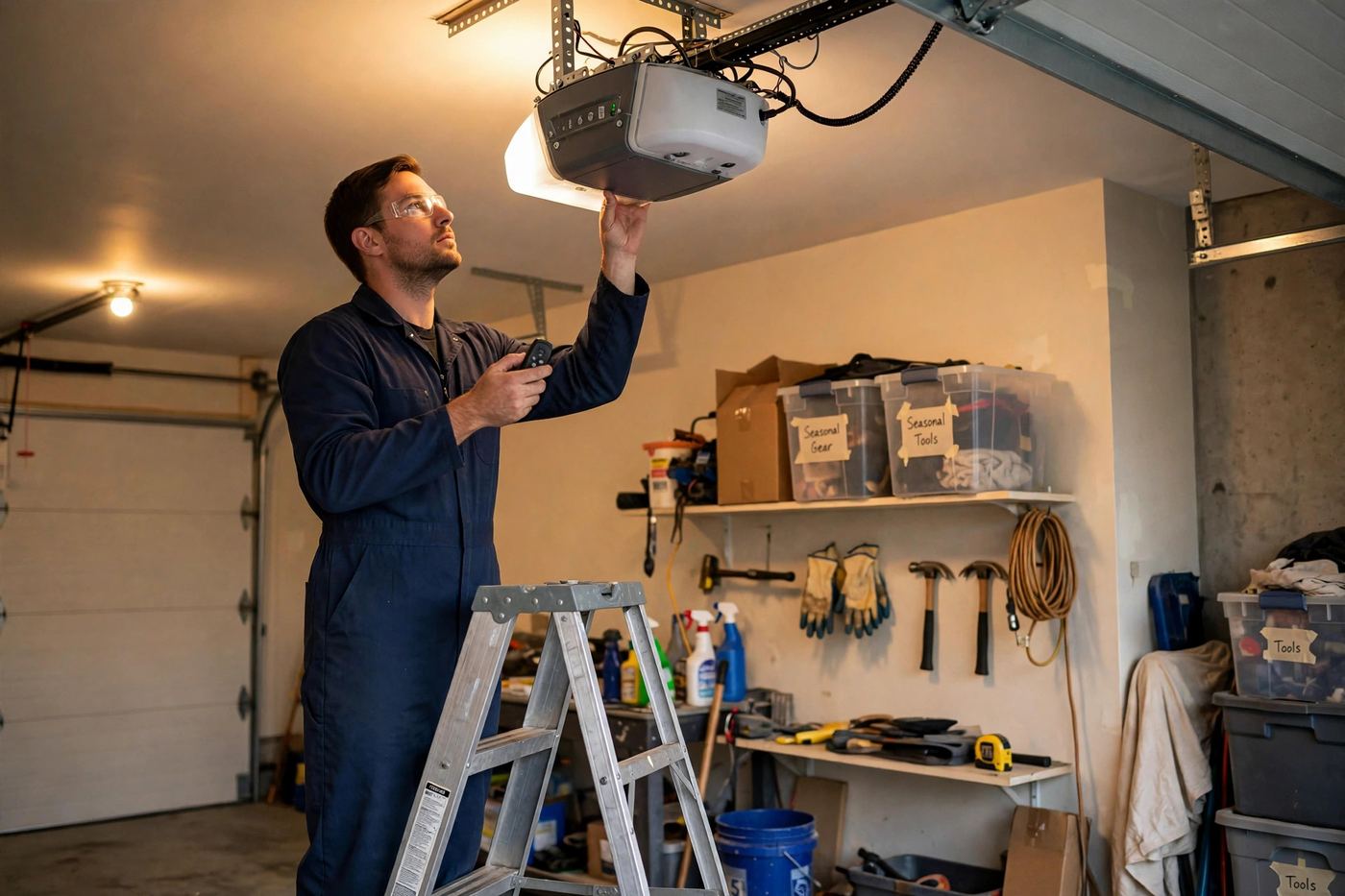
This guide covers what backup actually delivers — the honest cycle count, not the marketing one — which openers have it, what California's law requires and why it matters beyond California, how long the battery itself lasts, what replacement costs, and the monthly test that turns a hope into a system. If you are buying a new opener, this is the feature to decide on at purchase: adding it later is possible on some models and impossible on others.
In This Guide
- What Battery Backup Actually Does
- The Honest Runtime: Cycles, Door Weight and Cold
- California's Requirement — and Why It Matters Everywhere
- Battery Types, Lifespan and Replacement Cost
- Testing Your Backup: The Monthly Two-Minute Check
- Buying: Built-In Backup vs Add-On, and the Retrofit Question
- Backup Batteries and Home Generators: Different Jobs
- What to Do When the Battery Light Is Blinking
- The Outage Playbook: What to Do When the Power Goes Out
Key Takeaways
- When mains power fails, the opener's battery takes over the motor, the safety sensors, and the radio receiver — the whole system, not just the motor.
- Manufacturers typically quote battery backup in cycles — often around 20 to 50 open-close cycles on a full charge, depending on the model and the door.
- Since July 1, 2019, California law has required battery backup on every new residential garage door opener sold or installed in the state.
- Most current backup systems use a sealed 12-volt battery — lead-acid on many Chamberlain and LiftMaster models, lithium on some newer units.
- An untested backup battery is a hope, not a system — and the test takes two minutes.
- If you are buying a new opener, buy the backup built in.
- Homeowners sometimes ask whether a portable generator or a home battery makes opener backup redundant.
- Opener battery indicators communicate in a small vocabulary, and it is worth learning your model's version.
- Write this down somewhere the household can find it in the dark, because outages do not wait for anyone to look up a manual.
How to use this guide: work the checks in the order given — they're sequenced from the most common and cheapest causes to the rarest and most involved, which is exactly how a technician's diagnosis proceeds. Stop at the step that solves it, and stop entirely at anything involving springs, cables or a door that's crooked or off its tracks: those are professional jobs, and this guide will tell you plainly when you've reached one. If you reach the end without a fix, call (210) 964-8892 and tell the dispatcher which steps you completed — you'll skip half the diagnosis and get the right parts on the first truck.
What Battery Backup Actually Does
When mains power fails, the opener's battery takes over the motor, the safety sensors, and the radio receiver — the whole system, not just the motor. You operate the door normally from the remote, the keypad, or the wall button, and the opener runs its full safety logic: the photo-eye beam still guards the doorway and the door still reverses on contact. That last point matters more than it sounds. A battery backup that skipped the safety systems would be a liability; the ones on the market run the complete opener, just from a different power source.
What it does not do is run the door indefinitely. A backup battery is sized for a short outage — enough cycles to get the car out, get the car back in, and keep the household moving for a day or so — not for a week off-grid. It also does not power anything else: the garage lights on the opener unit may run, but the battery is not a household backup and will not carry freezers, routers, or anything else on the circuit. Expect a bridge over an outage, not a power station.
The Honest Runtime: Cycles, Door Weight and Cold
Manufacturers typically quote battery backup in cycles — often around 20 to 50 open-close cycles on a full charge, depending on the model and the door. Treat the top of that range as a laboratory number. The real count depends on three things: the door's balance, the battery's age, and the temperature. A well-balanced door costs the motor little per cycle; a heavy, dragging door costs it much more, and every extra pound of resistance is paid for in cycles. A battery in its first year delivers close to its rating; a four-year-old battery delivers a fraction of it.
Cold is the quiet thief. Like every lead-acid and lithium battery, backup batteries lose capacity in cold weather, which is why winter outages — the season when outages cluster in many states — are exactly when an aging battery underperforms. The practical translation: if your household needs two cycles a day during an outage (car out in the morning, car in at night), a healthy backup covers roughly a week of careful use, but plan for two to three days and treat anything beyond that as a bonus. And once the battery is exhausted, the door is back to manual operation — which is why the manual release check in the outage playbook below matters.
California's Requirement — and Why It Matters Everywhere
Since July 1, 2019, California law has required battery backup on every new residential garage door opener sold or installed in the state. The law followed a grim lesson from the 2017 wildfire evacuations, when residents in some neighborhoods could not open their garage doors during power shutoffs and were trapped with their cars inside. The requirement is now simply part of buying an opener in California: compliant models carry the backup built in, and the law is enforced at the point of sale and installation.
Outside California, battery backup is optional — but the reasoning travels. Any region with planned shutoffs, storm outages, or wildfire evacuation risk has the same failure mode: the car you need is behind a door that needs the grid. Even where it is not required, the feature costs relatively little at purchase — built into most current mid-range and premium models — and it is expensive or impossible to add to an opener that was never designed for it. If you live anywhere the power goes out more than once a year, treat backup as a standard requirement of your own, whatever your state's code says.
Battery Types, Lifespan and Replacement Cost
Most current backup systems use a sealed 12-volt battery — lead-acid on many Chamberlain and LiftMaster models, lithium on some newer units. The battery lives inside the opener's housing or in a clip-on compartment, charges continuously from mains power, and is expected to last 3 to 5 years in normal service. Heat shortens that life — a garage that bakes all summer ages batteries faster — and so does never being tested: a battery that has sat unexercised for years can fail silently, which is why the test schedule below exists.
Replacement is a small job. The battery itself typically costs $50-$150 depending on the model, and a professional replacement visit — battery, installation, disposal of the old unit, and a full test of the backup system — usually lands inside the standard opener repair band of $75-$300. On many models the swap is genuinely owner-doable: disconnect power, open the battery compartment, swap the connector, close up. Check your manual first, because on some units the battery is buried behind the motor cover and the savings are not worth the fiddling. Either way, note the install date on the battery: the replacement clock starts the day it goes in, not the day it fails.
Testing Your Backup: The Monthly Two-Minute Check
An untested backup battery is a hope, not a system — and the test takes two minutes. Once a month, with the door closed, switch off the opener's power at the breaker (or unplug the unit), then run the door through one full open-close cycle from the wall button. The door should travel at near-normal speed, the safety sensors should work, and the opener should not strain or stall. Then restore power and confirm the unit resumes charging — most models show a battery-status light, and a flashing or red indicator after power returns is a battery telling you its time is up.
Run the full version of the test once a season: two or three cycles on battery, watching for slowing travel or a door that stops short — both are the signature of a battery losing capacity. If the door will not run on battery at all, check the obvious first: the battery connector seated, the unit's battery switch (some models have one) on, and the battery's age. A battery past five years that fails the test has not betrayed you; it has retired on schedule, and replacement is the fix. Put the test on the same monthly cadence as the safety tests — the same five minutes, one more item on the list.
Buying: Built-In Backup vs Add-On, and the Retrofit Question
If you are buying a new opener, buy the backup built in. Current mid-range and premium models from Chamberlain, LiftMaster and Genie include it as standard, and the installed price of a mainstream opener — $350-$850 across most picks — already assumes it on those models. The built-in route is cleaner, warrantied as part of the unit, and tested as a system at the factory. Ask for the cycle rating and the battery type in writing at quote time; both are legitimate specification questions, and the answers separate models that look identical on the box.
If your existing opener lacks backup, the retrofit question has three answers depending on the model. Some current-generation openers accept a manufacturer battery kit that clips on and integrates properly. Some accept only a generic uninterruptible power supply (UPS) plugged between the wall and the opener — a workable hack that keeps the door running but does not integrate with the opener's battery monitoring, and whose runtime depends on the UPS size. And some older openers accept neither cleanly, in which case the honest answer is to fold backup into the next opener replacement rather than forcing it. The repair-or-replace math still applies: an opener past 12-15 years with a failing board and no backup is a replacement candidate, not a retrofit project.
Backup Batteries and Home Generators: Different Jobs
Homeowners sometimes ask whether a portable generator or a home battery makes opener backup redundant. It does not, quite, because the failure modes differ. A generator powers the house only after someone starts it, fuels it, and connects it — during exactly the evacuation or storm window when nobody wants an extra task. A home battery system does cover the opener automatically, but only if the garage circuit is on the backed-up panel, which it often is not; garage circuits are commonly left off backup panels to save capacity.
The opener's own battery is the layer that works with no decisions at all: power fails, battery takes over, door runs. It is also the layer that works when the failure is local — a tripped breaker, a single circuit out — rather than a grid event. The layers complement each other rather than replacing each other: the opener battery covers the door's own job for days, the generator or home battery covers the house if it covers the garage circuit at all. Check which circuits your backup system actually covers before assuming the garage is on it.
What to Do When the Battery Light Is Blinking
Opener battery indicators communicate in a small vocabulary, and it is worth learning your model's version. A steady green or amber light usually means charged and ready; a flashing light after power is restored usually means the battery is charging, testing, or failing — and the manual distinguishes those by blink pattern. A battery that never reaches steady charge after 24 hours on mains power is a battery that has reached the end of its chemistry, not a setting to adjust.
Before replacing, rule out the two cheap causes: the battery connector unseated by vibration (reseat it with power off), and the unit's battery switch or fuse if your model has one. If the light still will not settle, replace the battery and retest on the monthly schedule: power off at the breaker, one full cycle, power back on, steady light. A new battery that immediately passes that test has closed the case; a new battery that does not points at the charging circuit or the opener's board, which is a $150-$300 repair decision — and, on an opener past 12-15 years, a replacement conversation.
The Outage Playbook: What to Do When the Power Goes Out
Write this down somewhere the household can find it in the dark, because outages do not wait for anyone to look up a manual. Step one: try the door normally — if the backup is healthy, it just works, and the household should know that so nobody panics and forces anything. Step two: if the door does not move, check the opener's battery light and the breaker before assuming the worst; a tripped GFCI on the garage circuit is a common outage-adjacent gotcha.
Step three, the manual release, and only under the right conditions: with the door closed, pull the red cord and lift by hand — but only if the door lifts with manageable effort and stays level. If it feels impossibly heavy, hangs crooked, or you can see a gap in a spring coil, stop immediately: the counterbalance is gone, the car stays put, and the repair is a spring job, not an opener job. Step four: once the car is out, close the door and, if the outage will be long, disconnect the opener so a power surge on restoration does not take the board — surge protection fitted at the repair is the permanent version of this step.
Step five is the one people skip: after power returns, run the door once on mains power, run the safety tests, and check the battery light. An outage is a full-system test the grid administered for free; the households that learn from it — a battery replaced, a surge protector fitted, a release cord finally located in the dark — are the ones whose next outage is boring. And boring, in garage door ownership, is the entire goal.
Battery Backup Reference (2026)
| Item | Cost / Rating | Notes |
|---|---|---|
| Typical cycle rating | 20-50 cycles | Lab figure; balance, age and cold reduce it |
| Realistic outage cover | 2-3 days | Normal household use; treat more as a bonus |
| Battery lifespan | 3-5 years | Heat shortens it; test monthly, replace on test failure |
| Replacement battery, part only | $50-$150 | Sealed 12V; model-specific |
| Professional replacement visit | $75-$300 | Battery, install, disposal, full backup test |
| New opener with backup, installed | $350-$850 | Mainstream models; premium/camera units higher |
| California requirement | Since July 2019 | All new residential openers sold/installed in CA |
Frequently Asked Questions
How many times will my garage door open on battery backup?
Most current models are rated for roughly 20 to 50 cycles on a full charge, but the real number depends on your door's balance, the battery's age, and the temperature. Plan on two to three days of normal household use — car out in the morning, car in at night — and treat anything beyond that as a bonus. A heavy or dragging door spends cycles faster than a balanced one.
How long does an opener backup battery last?
Typically 3 to 5 years. Heat accelerates aging, so batteries in hot garages trend toward the short end, and a battery that is never tested can fail silently. Note the install date on the battery itself, and replace on the test result, not the calendar: a battery that fails the monthly power-off test is done, whatever its age.
How much does it cost to replace a garage door opener battery?
The battery itself runs $50-$150 depending on the model. A professional replacement visit — battery, installation, old-battery disposal, and a full backup test — usually lands inside the standard opener repair band of $75-$300. On many models the swap is owner-doable from the battery compartment; check your manual before opening the motor cover.
Is battery backup required by law?
In California, yes: since July 2019, every new residential opener sold or installed in the state must have battery backup. Elsewhere it is optional but increasingly standard on mid-range and premium models. If your region has storm outages, wildfire shutoffs, or planned power cuts, treat it as a requirement of your own regardless of code.
Can I add battery backup to my existing opener?
Sometimes. Some current models accept a manufacturer battery kit; others can run from a generic UPS plugged between the wall and the opener, though that does not integrate with the opener's battery monitoring. Older openers often accept neither cleanly — in that case, fold backup into your next opener replacement rather than forcing a retrofit onto aging hardware.
What do I do if the power is out and the battery is dead too?
Use the manual release: pull the red emergency cord with the door closed, then lift by hand — but only if the springs are intact and the door lifts with manageable effort. If the door feels impossibly heavy or hangs crooked, stop: that is the counterbalance telling you it is gone, and forcing the door risks a dropped door. In that case the car stays put and the repair is a spring job ($120-$350), not an opener job.
Will battery backup work if the door is heavy or off balance?
It will run, but badly: a heavy or dragging door spends cycles far faster than a balanced one, and an opener straining against a failing spring can exhaust a backup battery in a handful of cycles. If your door feels heavy by hand, the battery question is secondary — the spring question ($120-$350) comes first, because a balanced door is what makes the backup's cycle rating real.
Related Services
Garage Door Opener Repair
Opener hums, clicks or runs but the door won't move? We repair motors, gears, belts, boards and sensors for all major brands.
Learn more about garage door opener repair →Garage Door Opener Installation
New opener installed and programmed — quiet belt drives, battery backup, smartphone control and wall-mount options.
Learn more about garage door opener installation →Garage Door Repair
Complete diagnosis and repair for doors that won't open, close, balance or seal — most repairs finished in a single visit.
Learn more about garage door repair →← All garage door guides · Costs & pricing hub
Garage Door Stuck? We Can Fix It Today.
Same-day appointments and 24/7 emergency service across all 50 of our service cities. Upfront price before work starts — no surprises on the invoice.
(210) 964-8892 ☎ Call Now — Open 24/7