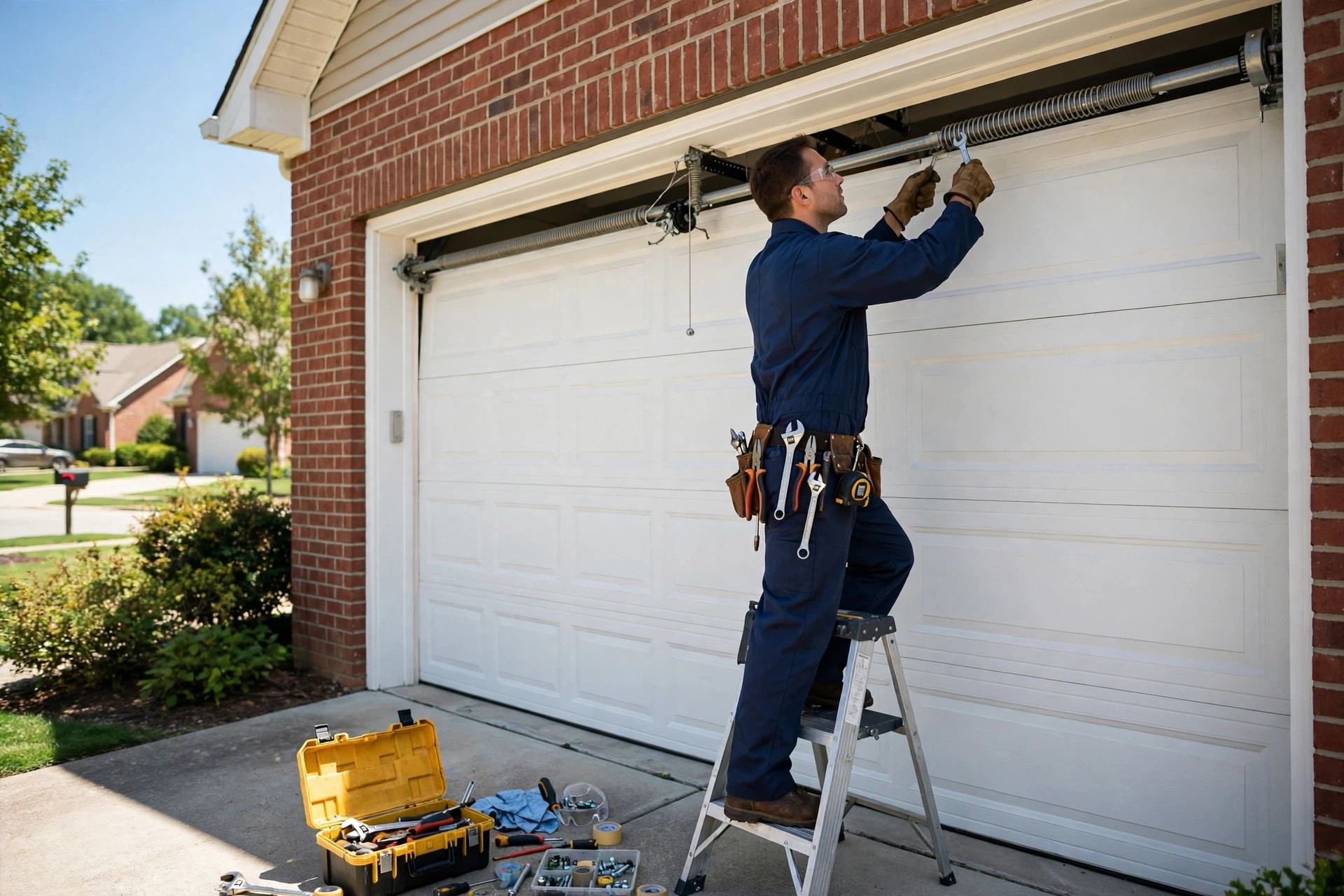
This guide prices each version of the job, explains why cables are always replaced in pairs, shows you the ten-second inspection that catches a cable in its cheap stage, and draws the safety line clearly — because a cable under spring tension is not a DIY part, no matter how simple it looks on the shelf.
In This Guide
- What the Cables Actually Do (and Why They Wear Out)
- The Cost Breakdown: Pair, Drums, and the Combo Job
- Why Both Cables Are Always Replaced Together
- The Ten-Second Check That Catches Cables in the Cheap Stage
- Why Cables Are Not a DIY Part
- Cable Materials: Galvanized, Stainless and Aircraft Cable, Priced
- The Door Reset: What a Snapped Cable Adds to the Bill
- Cable Failure and the Crooked Door: Your First Five Minutes
Key Takeaways
- Each lift cable runs from the door's bottom bracket up to a drum on the spring shaft.
- The cable pair itself is an inexpensive part — the invoice is mostly the skilled labor of working beside a tensioned spring system: taking the load off safely, threading and seating the new cables, setting drum timing so both sides wind evenly, and rebalancing the door.
- Homeowners sometimes ask to replace only the snapped cable.
- Once a quarter, with the door closed, look at each cable where it wraps toward the bottom bracket.
- The cable itself costs a few dollars at a hardware store, which makes this the most tempting false economy on the door.
- Residential lift cables are nearly all 7x19 aircraft cable — seven strands of nineteen wires — chosen because the fine-wire construction bends around drums thousands of times without the fatigue a coarse cable would suffer.
- A snapped cable rarely bills as a cable job alone.
- When a cable lets go, the door usually announces it by hanging crooked — one side dropped, sections racked against the tracks.
How to use this guide: find your situation in the tables, note the fair range, then compare it line by line with any quote you receive — including ours. If a number falls outside the ranges here, the right response isn't panic; it's one question: 'what's different about my door?' A good company answers it in specifics — door weight, part specification, timing — and a vague answer is itself the answer. When you're ready for an exact figure, call (210) 964-8892: our quotes are flat, written from the same data as this guide, and confirmed before any work begins.
What the Cables Actually Do (and Why They Wear Out)
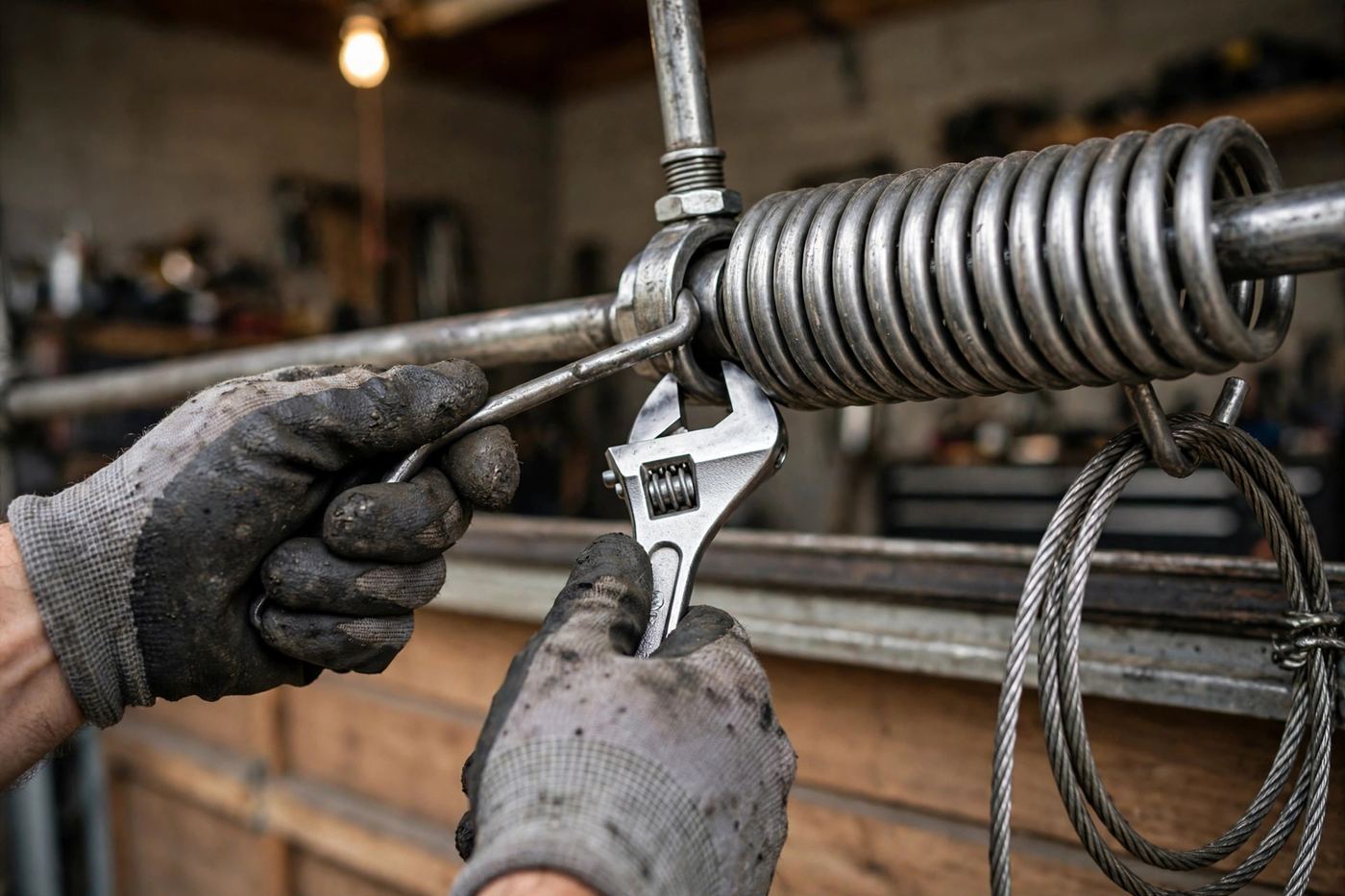
Each lift cable runs from the door's bottom bracket up to a drum on the spring shaft. As the door opens, the cable winds onto the drum; as it closes, it unwinds — carrying, at every moment, a full share of the door's weight as delivered by the springs. A standard residential cable is aircraft-grade galvanized steel, and it is not the cable's strength that fails first. It is the strands: individual wires fatigue where the cable bends around the drum and where it meets the bottom bracket, the two points of maximum flex and maximum grime.
Rust accelerates everything. In coastal and humid service areas — San Diego's salt air, Georgia and Gulf-side humidity — corrosion eats strands from the inside of the wrap outward, which is why a cable can look acceptable at a glance while half its strands are already gone at the bracket. The failure is progressive for months and then total in one cycle: the cable lets go, that side of the door drops, and the door racks crooked in its tracks. Everything about cable economics follows from that pattern — cheap and calm when caught fraying, urgent and bundled with a door reset when caught snapped.
The Cost Breakdown: Pair, Drums, and the Combo Job
The cable pair itself is an inexpensive part — the invoice is mostly the skilled labor of working beside a tensioned spring system: taking the load off safely, threading and seating the new cables, setting drum timing so both sides wind evenly, and rebalancing the door. A straightforward pair replacement on a healthy system lands at $80-$185. Add worn drums — grooved or cracked drums are a common root cause of cable wear — and the visit runs $150-$300. Bottom brackets with rusted cable pins price similarly when they join the job.
The combination to understand is cables plus springs. Because the technician is already working in the counterbalance system, pairing a cable replacement with a spring replacement ($120-$350) shares most of the labor: the combined job typically runs $350-$650 total rather than the sum of two separate visits. If your springs are late in their cycle count and a cable is fraying, the combo is the mathematically honest recommendation — one visit, one labor charge, and the whole lifting path renewed at once.
Why Both Cables Are Always Replaced Together
Homeowners sometimes ask to replace only the snapped cable. The answer is no, for the same reason springs are replaced in pairs: the surviving cable is the same age, has run the same cycles, and has frayed under the same conditions — it is simply the one that hasn't let go yet. Replacing one cable also creates a subtler problem: a new cable and a stretched, fatigued cable don't wind identically, so the door's two sides lift at slightly different rates and the door runs crooked at a level you can feel before you can see it.
The pair rule costs very little — the second cable is minutes of additional labor once the system is open — and it resets both sides to the same age, the same stretch, and the same inspection date. Any quote that prices a single-cable replacement on a two-cable door without discussing the twin is a quote that's optimizing for a return visit.
The Ten-Second Check That Catches Cables in the Cheap Stage
Once a quarter, with the door closed, look at each cable where it wraps toward the bottom bracket. You are looking for three things: strands sticking out like frayed rope, rust color bleeding through the wrap, and one cable hanging visibly looser than its twin. Any of the three means the cable is in its fraying stage — still working, still holding, and replaceable at the calm $80-$185 price on a scheduled visit instead of as part of an emergency.
Two rules govern what you find. Never touch a cable you suspect — a frayed cable is still carrying spring load, and strands under tension are sharp. And never run the door 'one more time' to test it: if the cable is down to its last strands, that cycle is the one that spends them. Photograph what you see, leave the door closed, and make the call. It is among the cheapest saves in all of home maintenance, and it takes ten seconds a quarter.
Why Cables Are Not a DIY Part
The cable itself costs a few dollars at a hardware store, which makes this the most tempting false economy on the door. The problem is not the cable — it is everything the cable is attached to. Replacing a lift cable means working at the bottom bracket, the exact point where spring tension transfers to the door. On a torsion system, the cable cannot be safely removed without controlling the spring's stored energy; on an extension system, the cable runs through pulleys under stretch. The injuries in this category are not scrapes — they are the predictable result of stored energy finding an uncontrolled path.
The honest division of labor is the one this site applies everywhere in the counterbalance system: you do the watching, a technician does the touching. Your ten-second quarterly check is genuinely valuable — it converts an emergency into an appointment. The wrench work belongs to someone with winding bars, vise-grip discipline, and a stocked truck if the drums turn out to be the real culprits. At $80-$185 for the pair, installed, balanced and safety-tested, the professional version of this job is also simply cheap.
Cable Materials: Galvanized, Stainless and Aircraft Cable, Priced
Residential lift cables are nearly all 7x19 aircraft cable — seven strands of nineteen wires — chosen because the fine-wire construction bends around drums thousands of times without the fatigue a coarse cable would suffer. The material choice is where climate enters: standard galvanized cable is the right default inland, while stainless cable earns its modest premium (typically $20-$50 more on a pair job) anywhere salt air works — coastal San Diego County, the Gulf side of Texas, New England shoreline towns where road salt joins sea air.
Diameter matters as much as material: cable is sized to the door's weight class, and an undersized cable installed because it was on the truck will fray on the same schedule that killed the original, only faster. When you get a cable quote, the specification worth hearing is the pair — material and diameter — not just 'new cables.' It's a fifteen-second conversation that tells you whether the replacement was spec'd or grabbed.
The Door Reset: What a Snapped Cable Adds to the Bill
A snapped cable rarely bills as a cable job alone. When one side lets go, the door racks in the tracks — and before any cable is replaced, the door must be stabilized, the remaining tension managed, crooked sections checked for hinge and roller damage, and the door re-squared in its tracks. That reset labor is why a snapped-cable visit typically lands at $125-$400 all-in while the planned fraying-stage replacement sits at $80-$185 for the cables themselves.
The inspection that comes with the reset is genuinely part of the value: the cause is in there somewhere — a grooved drum chewing cables, a rusted bottom bracket, a fray pattern that started at a rub point. Replacing cables without finding the cause is renting the same emergency twice. If your quote for a snapped cable doesn't mention the cause, ask for it by name.
Cable Failure and the Crooked Door: Your First Five Minutes
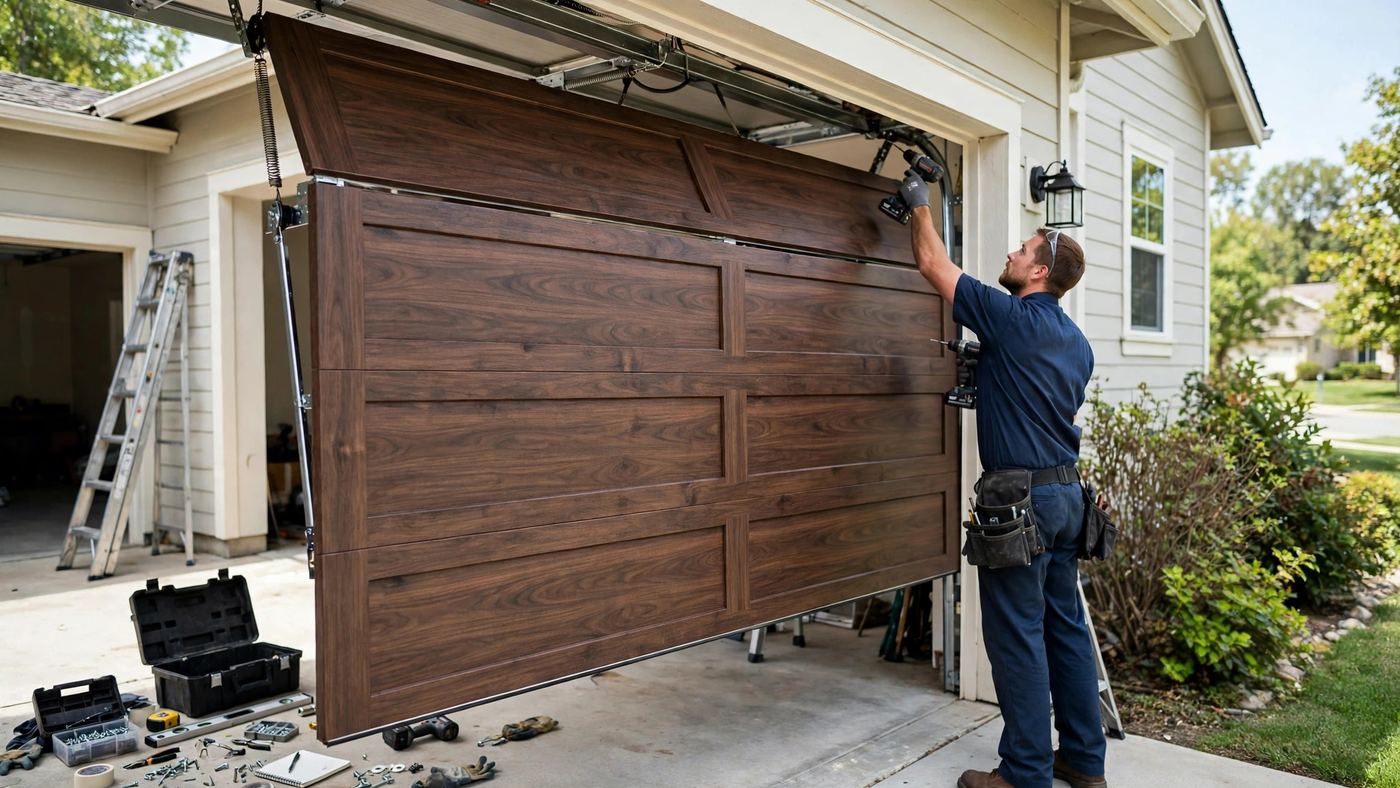
When a cable lets go, the door usually announces it by hanging crooked — one side dropped, sections racked against the tracks. Your first five minutes decide how much of the repair bill is the cable and how much is the aftermath. Step one: stop. Don't run the opener again, don't try to straighten the door, and don't let anyone duck under it. A racked door is held by the surviving cable and friction; every movement spends both.
Step two: secure the scene. Keep kids and pets out of the garage, and if the door is your home's open boundary, note that for dispatch — a door hanging open gets sequenced as the security issue it is. Step three: photograph the door's position and the cable ends if they're visible from a safe distance. Those photos tell the dispatcher what's coming and get the right parts — cables, possibly drums, and the reset clamps — onto the first truck.
Then make the call and describe it in the vocabulary of this guide: which side dropped, whether you heard a snap or the door simply sagged, and whether the car is trapped. Cable-plus-reset is typically a $125-$400 visit with the cause found and fixed — and the doors that bill at the top of that band are almost always the ones someone tried to 'help' back into place first.
Cable Replacement Price Reference (2026)
| Item | Cost / Rating | Notes |
|---|---|---|
| Cable pair, planned replacement | $80-$185 | Caught fraying; calm scheduled visit |
| Cables + drums | $150-$300 | Grooved or cracked drums were the cause |
| Snapped cable + door reset | $125-$400 | Door racked; reset and inspection included |
| Cables + springs combo | $350-$650 | Whole lifting path renewed in one visit |
| Stainless cable upgrade | +$20-$50 | Coastal and salt-air service areas |
Frequently Asked Questions
Should both garage door cables be replaced at the same time?
Yes. The surviving cable is the same age and has frayed under the same conditions — it just hasn't let go yet. A pair also winds evenly, so the door lifts level. The second cable adds only minutes of labor once the system is open, so the pair is barely more expensive than the single.
How much does garage door cable replacement cost?
A pair typically runs $80-$185 installed. If worn drums or bottom brackets join the job, expect $150-$300; if cables are replaced together with springs — a common and sensible combination — the combined visit usually totals $350-$650.
What are the warning signs of a failing cable?
Strands sticking out like frayed rope, rust bleeding through the cable wrap, one cable hanging looser than its twin, or a door that has started rising slightly crooked. Any of these means schedule a replacement now, while it's still the cheap version of the job.
Can I drive my car out if a cable snapped?
No. With one cable gone, the door is hanging by the remaining cable and whatever the tracks are catching. Running the opener or forcing the door can drop that side completely. Leave the door exactly as it sits and call — a snapped cable with a reset is typically a $125-$400 visit.
How long does cable replacement take?
About an hour for a straightforward pair, including drum inspection, re-seating, balancing and the safety tests. If drums or brackets are replaced in the same visit, allow up to two hours.
Does a snapped cable damage the door itself?
It can. When one side drops, the door racks — hinges bend, rollers pop or crack, and a section can crease if the door is forced afterward. That's why the first rule of a snapped cable is to leave the door exactly as it sits: the damage tally is usually smallest at the moment of failure, and grows only when the door is moved.
Related Services
Garage Door Cable Repair
Snapped or frayed lift cables leave doors crooked and dangerous. We replace cables in pairs with drums inspected and reset.
Learn more about garage door cable repair →Broken Spring Replacement
Snapped torsion or extension spring? We replace springs in matched pairs, sized exactly to your door's weight — same-day.
Learn more about broken spring replacement →Garage Door Repair
Complete diagnosis and repair for doors that won't open, close, balance or seal — most repairs finished in a single visit.
Learn more about garage door repair →← All garage door guides · Costs & pricing hub
Garage Door Stuck? We Can Fix It Today.
Same-day appointments and 24/7 emergency service across all 50 of our service cities. Upfront price before work starts — no surprises on the invoice.
(210) 964-8892 ☎ Call Now — Open 24/7