It also covers the two decisions that matter more than brand: drive type (belt, chain, screw or wall-mount) and power sizing. Get those two right and almost any current-generation unit from the big three — LiftMaster, Chamberlain, Genie — will serve you a decade or more. Get them wrong and the best brand on the shelf will disappoint you by spring.
In This Guide
- How We Pick: The Criteria That Actually Predict Satisfaction
- Best Overall and Best Premium: The Belt-Drive Leaders
- Best Value and Best Quiet: The Genie Side of the Shelf
- Drive Types and Horsepower: The Two Decisions Under Every Pick
- Smart Openers: Wi-Fi, Cameras, Apps — and Making Your Current Opener Smart
- Opener Prices: Unit vs Installed, Honestly Compared
- What We Install Most — and What Comes Back
- After the Install: Programming, Codes and the First Month
Key Takeaways
- Installers judge openers by what generates callbacks, and the list is short.
- Best overall: the Chamberlain B6753T.
- Best value: the Genie 7155-TKV StealthDrive — a belt-drive unit with Wi-Fi (Genie's Aladdin Connect platform) at a $200-$250 unit price, installed typically $450-$650.
- Belt drive is the modern default: a steel-reinforced belt on a DC motor — quiet, smooth, low-maintenance, and priced in the middle.
- Smart features have collapsed into one question: do you want alerts and control from your phone? The built-in route — myQ on Chamberlain and LiftMaster, Aladdin Connect on Genie — adds open/close alerts, remote operation from anywhere, scheduled auto-close (the feature that ends the 'did I close it?' drive-back), and, on camera models, a live view of the garage that doubles as a delivery watch: Amazon Key in-garage delivery works with myQ where available.
- Opener shopping confuses people because both numbers are real: the shelf price of the unit, and the installed total that includes removal of the old opener, the rail matched to your door's height, new photo-eye sensors, programming for every remote and vehicle, force and travel calibration, both safety tests, and haul-away.
- Field patterns from our own trucks: belt-drive DC units from the big three generate the fewest callbacks of any category we install, and the callbacks they do generate are overwhelmingly app-and-pairing questions, not mechanical failures.
- A new opener's first month sets patterns that last its whole life, and three setup tasks deserve more than the installer's default pass.
How to use this guide: work the checks in the order given — they're sequenced from the most common and cheapest causes to the rarest and most involved, which is exactly how a technician's diagnosis proceeds. Stop at the step that solves it, and stop entirely at anything involving springs, cables or a door that's crooked or off its tracks: those are professional jobs, and this guide will tell you plainly when you've reached one. If you reach the end without a fix, call (210) 964-8892 and tell the dispatcher which steps you completed — you'll skip half the diagnosis and get the right parts on the first truck.
How We Pick: The Criteria That Actually Predict Satisfaction
Installers judge openers by what generates callbacks, and the list is short. Noise: a unit over a bedroom or beside a nursery gets judged at 6 a.m., not at the showroom. Pull consistency: DC motors with soft start and stop treat the door's hardware measurably gentler than bargain AC units that yank. Parts horizon: a model whose boards, gears and remotes will still be stocked in ten years. And the ecosystem question — whose app, whose accessories, whose battery — because an opener is now a platform you live with, not a motor you forget.
One more criterion owners underrate until they need it: battery backup. In outage-prone and storm regions it is the difference between a door and a wall, and in California it has been legally required on new residential opener installations since 2019. Where prices appear below, the unit price and the professionally installed price are both given — the installed figure is the honest one to budget, and it typically runs $350-$850 across this guide's picks, with premium camera and wall-mount models reaching $700-$900.
Best Overall and Best Premium: The Belt-Drive Leaders
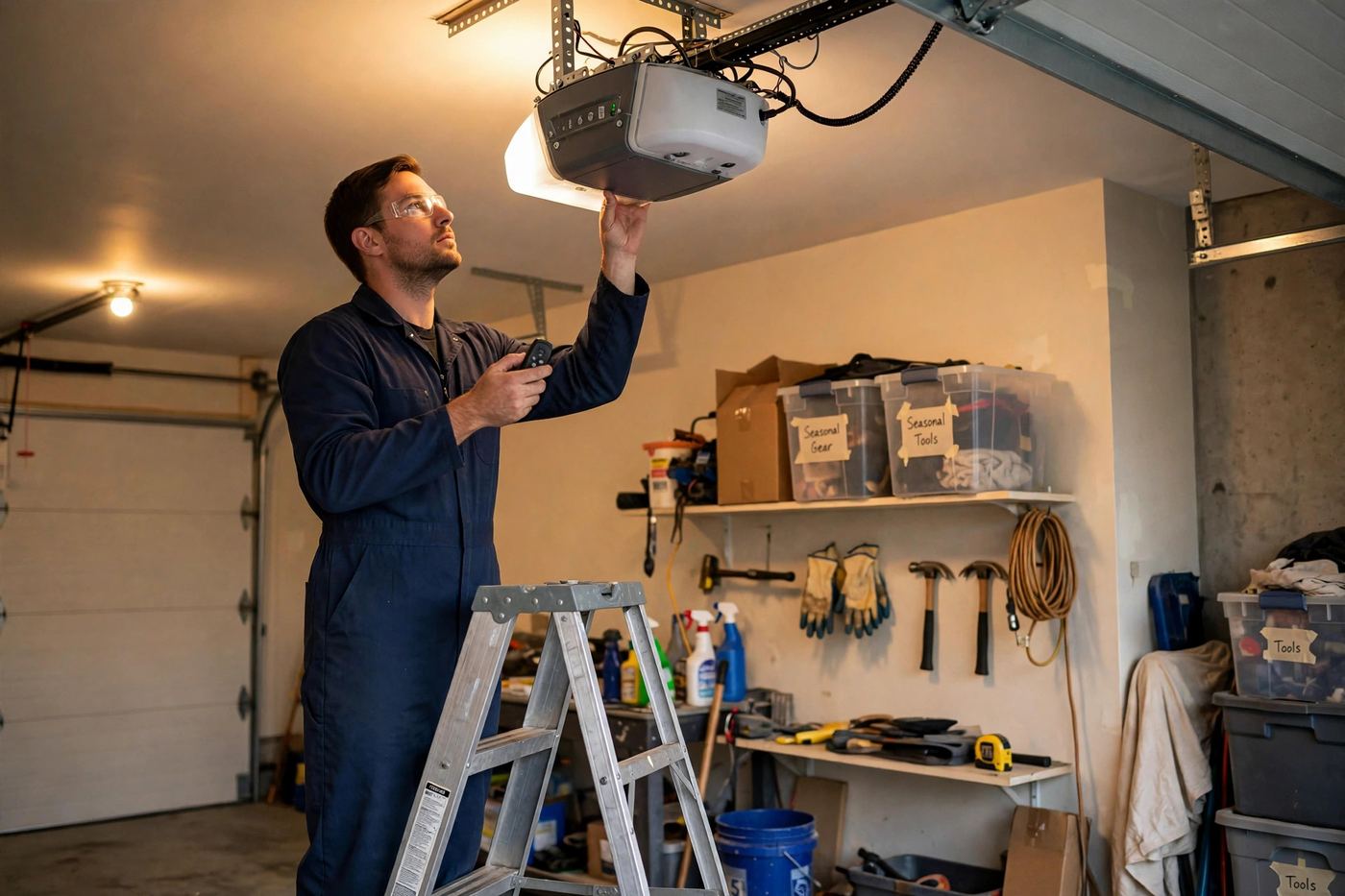
Best overall: the Chamberlain B6753T. A 1.25-HP-equivalent DC belt drive, quiet enough for attached garages, with a built-in 1080p camera, corner LED lighting, battery backup and myQ built in. Unit price runs roughly $300-$400; professionally installed, expect it inside the $550-$850 band depending on your door's condition and rail length. It is the opener that asks the fewest compromises of a typical two-car home, which is why it tops installer lists year after year.
Best premium: the LiftMaster 87504-267 — Chamberlain's professional-line sibling (same parent company, sold through installers), with the same camera-and-battery formula in a heavier-duty build and a stronger warranty structure; figure $450-$500 for the unit. For homes where the ceiling itself is the constraint — cathedral ceilings, low headroom, or overhead storage plans — the pick changes shape entirely: the LiftMaster 8500W wall-mount (jackshaft) unit mounts beside the door, drives the shaft directly, and frees the whole ceiling; around $690 for the unit, and the quietest mechanical arrangement of all because there is no rail to rattle.
Best Value and Best Quiet: The Genie Side of the Shelf
Best value: the Genie 7155-TKV StealthDrive — a belt-drive unit with Wi-Fi (Genie's Aladdin Connect platform) at a $200-$250 unit price, installed typically $450-$650. It skips the camera and some lighting flourish, and keeps the parts that matter: quiet drive, battery-backup availability, and a brand with a genuine parts network. For a detached garage or a home where the opener is a utility rather than a gadget, this is the rational buy.
Best quiet: the Genie StealthDrive Connect and SilentMax family earn the title in bedrooms-over-garage homes — belt drive plus a DC motor tuned for soft starts, the combination that removes both the rumble and the jolt. A quietness note that saves disappointment: the opener is only half the sound. Worn steel rollers will make the quietest opener loud; if quiet is the goal, budget for sealed nylon rollers in the same conversation, and the whole system drops to a hum.
Drive Types and Horsepower: The Two Decisions Under Every Pick
Belt drive is the modern default: a steel-reinforced belt on a DC motor — quiet, smooth, low-maintenance, and priced in the middle. Chain drive is the budget classic: durable and cheaper, louder, and happier in detached garages. Screw drive has few moving parts and suits extreme-temperature regions, with fewer current models to choose from. Wall-mount (jackshaft) drives the torsion shaft directly — premium-priced, ceiling-freeing, and the pick for tall or heavy doors with the right shaft setup. There is no bad modern drive type; there are only mismatches between drive and household.
Horsepower is the second decision, and it is widely misunderstood: the opener guides a balanced door rather than lifting it, so power sizing is about margin, not muscle. A 1/2-HP-equivalent unit handles a standard single or light double door. A 3/4 to 1.25-HP-equivalent unit is the right margin for heavy insulated doubles, wood doors, and high-cycle households — it starts without strain and its components live longer for it. Oversizing a light door buys nothing; undersizing a heavy one taxes every start. Your door's weight, which a technician measures at the quote, settles the question.
Smart Openers: Wi-Fi, Cameras, Apps — and Making Your Current Opener Smart
Smart features have collapsed into one question: do you want alerts and control from your phone? The built-in route — myQ on Chamberlain and LiftMaster, Aladdin Connect on Genie — adds open/close alerts, remote operation from anywhere, scheduled auto-close (the feature that ends the 'did I close it?' drive-back), and, on camera models, a live view of the garage that doubles as a delivery watch: Amazon Key in-garage delivery works with myQ where available. Voice-assistant control of the door itself is deliberately restricted by the platforms on security grounds — expect status checks ('is the door closed?') rather than open-by-voice, and treat that as a feature, not a gap.
Already have a healthy opener? The retrofit route makes it smart without replacing it: a controller kit — Genie's Aladdin Connect kit or Chamberlain's myQ Smart Garage Control, roughly $80-$100 — mounts at the ceiling, talks to your existing opener like a remote, and adds the same alerts and app control. It is the right spend when the opener is young and only its radio is dated. It is the wrong spend when the opener is failing — put the money in a new unit with Wi-Fi built in, and the smart features arrive on hardware with a decade of life in it. Either way, erase old codes when you set any of this up: a new platform is the perfect moment for a clean access slate.
Opener Prices: Unit vs Installed, Honestly Compared
Opener shopping confuses people because both numbers are real: the shelf price of the unit, and the installed total that includes removal of the old opener, the rail matched to your door's height, new photo-eye sensors, programming for every remote and vehicle, force and travel calibration, both safety tests, and haul-away. A $300 unit is typically a $550-$750 finished job; a $690 wall-mount is typically an $850-$1,100 finished job in difficult geometry or a straightforward one at the band's lower edge. Compare quotes on the installed total with the model named — 'new opener, installed' with no model is not a quote, it's a placeholder.
Where the installed total legitimately moves: door height above seven feet (longer rail), a door whose balance problems must be fixed first (springs are separate money, always), and electrical work if the ceiling outlet is missing or dead. A company that walks the garage before quoting has priced those; a company that quotes from the phone has deferred them to your doorstep.
What We Install Most — and What Comes Back
Field patterns from our own trucks: belt-drive DC units from the big three generate the fewest callbacks of any category we install, and the callbacks they do generate are overwhelmingly app-and-pairing questions, not mechanical failures. Wall-mount jackshaft units delight their owners disproportionately — the freed ceiling is a daily pleasure — but they're the pickiest install: shaft condition and door balance must be genuinely right, which is why they're a professional-line product. Chain drives remain the honest budget answer for detached garages, and their 'failures' in our records are usually the door's springs misdiagnosed as the opener.
The pattern worth internalizing: openers rarely die young of their own defects. They die of workload (heavy doors), weather (surges), and neglect (a decade without a balance check). Choose the model by your household's noise, weight and ceiling facts, then protect the choice with a surge protector and a balanced door — that combination, not any brand logo, is what a fifteen-year opener actually looks like.
After the Install: Programming, Codes and the First Month
A new opener's first month sets patterns that last its whole life, and three setup tasks deserve more than the installer's default pass. First, codes: program every remote, keypad and vehicle, then erase anything carried over from the old unit — an opener swap is the natural moment for a clean access slate, and a remote lost two years ago should not still open your new door. Give the house sitter and the kids their own keypad code rather than the family master; codes can be changed individually later.
Second, the app: enable open/close alerts and the auto-close schedule if your household is a 'did we close it?' household — most are. The alert log quietly becomes a security feature (the 2 a.m. opening you didn't make is worth knowing about), and the camera models add the visual confirmation that ends porch-package anxiety for delivery households.
Third, the verification pass: within the first week, run the two safety tests yourself (photo-eye wave, 2x4 reverse) even though the installer demonstrated them. You're confirming the system in your hands, on your door, and starting the monthly habit while the opener is new and the routine is easy to adopt. File the model, serial and warranty paperwork with the tests' dates — in ten years, that folder is what a repair-or-replace decision gets made from.
2026 Opener Picks at a Glance
| Item | Cost / Rating | Notes |
|---|---|---|
| Chamberlain B6753T | Best overall | Belt, camera, myQ, battery backup; ~$300-$400 unit |
| LiftMaster 87504-267 | Premium / heavy use | Pro-line belt, camera; ~$450-$500 unit |
| LiftMaster 8500W | Wall-mount | Jackshaft; frees ceiling; ~$690 unit |
| Genie 7155-TKV | Best value | Belt + Aladdin Connect; ~$200-$250 unit |
| Genie StealthDrive Connect | Quietest | Belt, DC soft start/stop; battery option |
| Retrofit controllers | Make yours smart | Aladdin Connect / myQ Control; ~$80-$100 |
Frequently Asked Questions
What is the best garage door opener in 2026?
For most homes, the Chamberlain B6753T — quiet belt drive, built-in camera, battery backup and myQ control. Heavy-use and premium installs favor the LiftMaster 87504-267; tight ceilings favor the wall-mount LiftMaster 8500W; budgets favor the Genie 7155-TKV. The right answer is a match between the model and your door, not a single model for every garage.
Belt, chain or screw drive — which should I choose?
Belt for attached garages and any home that values quiet — it's the modern default. Chain for detached garages and tight budgets; it's durable and cheaper, just louder. Screw for extreme climates with few moving parts to maintain. Wall-mount jackshaft when ceiling space or door height rules out a rail.
How much horsepower do I need?
A 1/2-HP-equivalent motor suits standard single and light double doors. Step up to 3/4-1.25 HP-equivalent for heavy insulated or wood doubles and high-cycle households. The opener guides a balanced door rather than lifting it, so you're buying starting margin and component longevity, not raw lifting power.
How much does a new opener cost, installed?
Across the mainstream picks in this guide, professional installation typically totals $350-$850 including the unit, new sensors, programming and haul-away. Premium camera models and wall-mount units run $700-$900 installed. A quote should state the exact model — opener pricing is model-driven.
Should I get battery backup?
If your region loses power with any regularity, yes — it's the difference between a door and a wall during an outage, and California requires it on new residential installations. It also protects the opener's electronics from some surge behavior when power returns. On most current models it adds modest cost at purchase and is expensive to retrofit later.
LiftMaster or Chamberlain — what's the actual difference?
Less than the marketing suggests: they're sister brands under the same parent, sharing myQ and much engineering. Chamberlain is the retail line (you buy the box); LiftMaster is the professional line (installer-sold, often heavier builds and warranty structures). For most homes the choice is which channel you're buying through; for heavy doors and pro installation, LiftMaster's line has the deeper bench.
Related Services
Garage Door Opener Installation
New opener installed and programmed — quiet belt drives, battery backup, smartphone control and wall-mount options.
Learn more about garage door opener installation →Garage Door Opener Repair
Opener hums, clicks or runs but the door won't move? We repair motors, gears, belts, boards and sensors for all major brands.
Learn more about garage door opener repair →Garage Door Repair
Complete diagnosis and repair for doors that won't open, close, balance or seal — most repairs finished in a single visit.
Learn more about garage door repair →← All garage door guides · Costs & pricing hub
Garage Door Stuck? We Can Fix It Today.
Same-day appointments and 24/7 emergency service across all 50 of our service cities. Upfront price before work starts — no surprises on the invoice.
(210) 964-8892 ☎ Call Now — Open 24/7